




A red porch light does not have a recognized meaning as a signal for drugs or drug dealing. Police and DEA materials do not identify a red porch bulb as a standard code for drug activity. In most cases, a red porch light is used for a cause, holiday, decoration, or personal preference.
The rumor that porch-light colors reveal specific drugs has circulated for years, but there is no credible law-enforcement evidence establishing a standard color code. If you’re concerned about drug activity at a nearby home, the behavior around the property matters far more than the color of its porch light.
Quick overview
- Most common real reason: support for heart health in February, tied to the American Heart Association’s Go Red for Women campaign.
- Other real reasons: International Firefighters’ Day on May 4, holidays like Valentine’s Day, and personal taste.
- Actual warning signs of drug activity: many short visits, odd hours, and quick exchanges at the door or a car window.
- If you’re worried: write down what you see and call your local police non-emergency line or use the DEA online tip form.
- If you want a red bulb yourself: pick an outdoor-rated red LED and check your HOA rules first.
Short answer: A red porch light has no official drug meaning. Police and DEA sources I found list behaviors as warning signs, and bulb color is not one of them. The “red light means drug house” idea is an urban rumor that spread during the drug panic of the 1980s and 1990s.
What does a red porch light mean for drugs?
A red porch light does not officially indicate drug activity. There is no recognized police or DEA system in which a red porch bulb means that drugs are available at a particular home.
The commonly repeated rumor sometimes assigns different drugs to different light colors, such as red, blue, or green. However, those color charts are not supported by the law-enforcement sources reviewed for this topic.
That distinction matters. A person could theoretically use any color as a private signal, but that does not make it an established or reliable code.
Why the rumor is misleading
A porch light is highly visible from the street. If a specific color reliably identified a drug house, it would be an unusually obvious way to advertise illegal activity.
Law-enforcement guidance instead focuses on patterns of behavior, such as repeated short visits, unusual traffic, exchanges between people or vehicles, and other evidence of possible illegal activity.
So, a red bulb by itself tells you very little.
Where did the red porch light drug rumor come from?
The exact origin of the rumor is difficult to establish. Online sources commonly connect the story with drug-related fears and urban legends that circulated during the late 20th century, but there is no clear authoritative record showing when the alleged color code began.
Some versions claim that different colors represent different drugs. These claims are frequently repeated online, but repetition is not evidence that the system was ever widely used or recognized by law enforcement.
Is red connected with crime?
Part of the confusion may come from the long-standing phrase “red-light district,” which refers to areas historically associated with prostitution and adult entertainment.
That association does not mean that a red porch light outside an ordinary home carries the same meaning.
A residential red light can have a completely unrelated purpose, including decoration, awareness campaigns, or simply personal preference.
Do drug dealers use porch-light colors as a code?
There is no established porch-light color code recognized by police or the DEA for identifying drugs.
That does not mean an individual could never use a colored light as a private signal. It means you should not treat the color itself as evidence of drug activity.
For example, Seattle Police guidance on suspected drug activity focuses on observable circumstances such as unusual traffic, short visits, exchanges, drug paraphernalia, and other potentially relevant behavior. A particular porch-light color is not listed as a standard indicator.
Prince William County police similarly emphasize that suspected drug activity should be considered through multiple indicators rather than one isolated observation.
What does a red porch light actually mean?
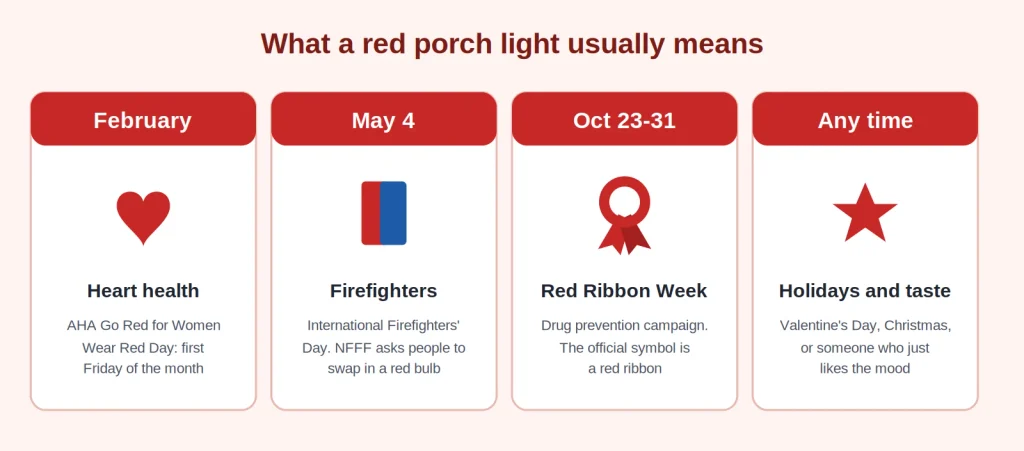
A red porch light can have several legitimate meanings. The most common explanation depends on the season, event, household, or person using it.
People use colored porch lights for holidays, awareness campaigns, community events, and personal preferences. For example, blue porch lights can also have different meanings depending on the context.
| Possible meaning | When you may see it | What it represents |
|---|---|---|
| Heart health awareness | February | Support for heart-health awareness |
| Firefighter recognition | Around May 4 | Support for firefighters |
| Drug prevention awareness | October | Red Ribbon Week-related decoration |
| Holiday decoration | Various dates | Seasonal or festive decoration |
| Personal preference | Any time | Style or outdoor lighting |
| Community campaign | Varies | Support for a local cause or event |
Red lights and heart health
February is associated with American Heart Month, and the American Heart Association’s Go Red for Women campaign uses red to raise awareness of cardiovascular health.
The American Heart Association promotes wearing red and uses red in awareness activities. Some homeowners also choose red outdoor lighting during February, although that does not mean every red porch light is officially part of an AHA campaign.
Red lights and firefighters
Red porch lights can also be used to recognize firefighters, particularly around May 4, International Firefighters’ Day.
Some fire-safety and firefighter-awareness campaigns encourage people to display red lights as a gesture of support. Therefore, seeing a red porch light around early May may have nothing to do with drugs.
Red lights and drug prevention
There is another interesting connection between red lights and drugs, but it is almost the opposite of the rumor.
Red Ribbon Week, held annually in October, is a major drug-prevention awareness campaign in the United States. The red ribbon represents support for drug-free communities and drug-prevention education.
However, the existence of Red Ribbon Week does not establish a rule that a red porch light means a home is participating in the campaign. Treat it as one possible explanation rather than a universal signal.
Could it simply be decoration?
Yes.
People use colored porch bulbs for holidays, parties, seasonal decorations, neighborhood events, and personal style. A red bulb can also simply be someone’s preferred lighting color.
If you genuinely want to know why a neighbor has a red porch light, asking them is more reliable than interpreting the color through an internet rumor.
What are the real signs of possible drug activity?
If you’re concerned about a property, focus on observable patterns rather than lighting color.
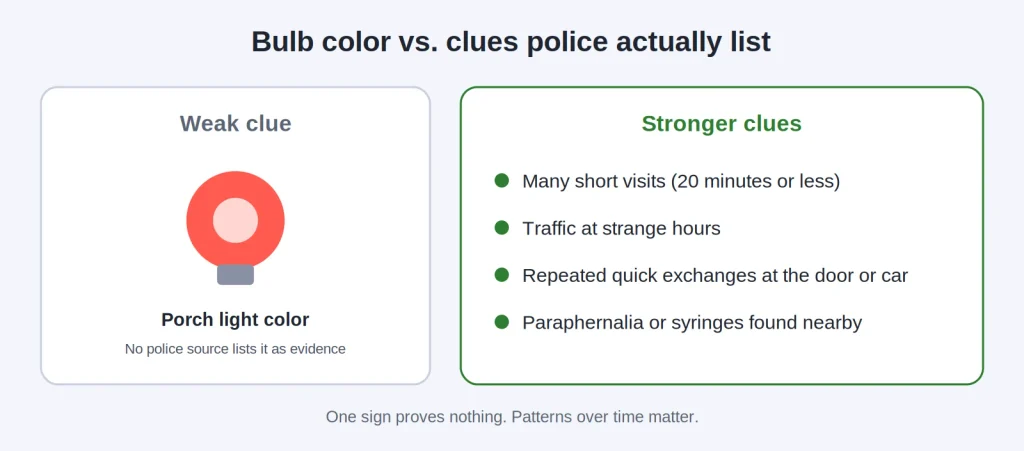
Potential indicators mentioned in law-enforcement guidance can include:
- Frequent short visits throughout the day or night
- Repeated vehicle traffic at unusual hours
- People arriving, entering briefly, and leaving quickly
- Quick exchanges involving people or vehicles
- Vehicles stopping briefly while someone enters the property
- Possible drug paraphernalia
- Strong or unusual odors associated with drug production
- Unusual security measures combined with other suspicious activity
- Activity that consistently differs from normal residential use
None of these signs automatically proves that a person is selling or using drugs. A single observation can have an innocent explanation.
For example, a home-based business could naturally have frequent visitors, while shift workers may regularly come and go during unusual hours.
The important distinction is a repeated pattern supported by multiple observations, not one suspicious-looking detail.
What should you do if you suspect drug activity?
Don’t confront the occupants based on a suspicion. Instead, document what you can observe safely and use the appropriate reporting channel.
1. Document observable details
If you believe there is an ongoing problem, record:
- Dates and times
- General vehicle descriptions
- Repeated patterns of activity
- What you actually observed
Avoid trespassing, following people, or putting yourself in danger to collect evidence.
2. Use the appropriate police number
For an immediate threat involving violence, weapons, a fire, or another emergency, use your local emergency number.
For an ongoing concern that is not an emergency, use your local police department’s non-emergency reporting process.
3. Consider anonymous reporting
Depending on your location, police departments, Crime Stoppers organizations, or national agencies may offer anonymous tip options.
The DEA also provides a mechanism for submitting information about suspected drug-related activity in the United States.
4. Don’t confront the suspected occupants
A porch light is not evidence of drug dealing, and confronting a neighbor based on an unverified assumption can create unnecessary conflict.
If there is a genuine safety concern, let the appropriate authorities assess the situation.
Can you use a red porch light without causing suspicion?
Yes. A red porch light is not inherently a sign that your home is associated with drugs.
If you’re using one for an awareness campaign or another specific reason, you can make the purpose obvious by:
- Using it during the relevant awareness period
- Adding a small sign explaining the cause
- Mentioning the reason in a neighborhood group
- Returning to a standard white or warm-white bulb afterward
For example, a red light during February is easier for neighbors to associate with heart-health awareness than a red light used randomly throughout the year.
How Do You Choose a Red Porch Light Bulb?
For an outdoor fixture, choose a red LED bulb that is compatible with the fixture and rated for its installation environment.
Check these specifications before buying:
- Base type: Match the bulb base to your fixture.
- Outdoor rating: Use a bulb rated for damp or wet locations when required.
- Wattage: Stay within the fixture manufacturer’s maximum rating.
- Brightness: Choose an appropriate lumen output for the porch.
- Color: Look for a bulb designed to emit red light rather than modifying a standard bulb.
- Dimming: If the fixture uses a dimmer, make sure the bulb is dimmer-compatible.
LEDs are generally a practical choice for porch lighting because they use considerably less electricity and typically last much longer than incandescent bulbs.
The Bottom Line
A red porch light is not a recognized signal that a home has drugs or that a drug dealer is operating there. The color alone is not reliable evidence of criminal activity.
Red porch lights can represent heart-health awareness, firefighter recognition, drug-prevention campaigns, holidays, decoration, or nothing more than personal preference.
If you’re concerned about a particular property, don’t try to decode the bulb. Look for consistent, observable behavior and let local authorities determine whether there is a legitimate reason for concern.
FAQs
Is a red porch light a signal for drug dealers?
No established police or DEA source identifies a red porch light as a standard signal for drug dealers. A red light by itself is not evidence of drug activity.
Does a red porch light mean prostitution?
Not necessarily. The association may come from the term “red-light district,” but that historical term does not establish a meaning for red porch lights at residential properties.
Is it illegal to have a red porch light?
A red porch light is not generally illegal simply because it is red, but local lighting regulations, building rules, or HOA restrictions can vary. Check your local requirements if you’re unsure.
What does a red porch light mean in February?
It can represent heart-health awareness because February is American Heart Month. It can also be used for Valentine’s Day decoration or simply as a personal lighting choice.
What do green or blue porch lights mean?
Green and blue porch lights can be associated with different awareness campaigns, holidays, causes, or personal preferences. Online claims that specific colors consistently identify particular drugs are not supported by established law-enforcement color codes.
Sources
- American Heart Association, Go Red for Women and National Wear Red Day 2026: newsroom.heart.org and goredforwomen.org
- NHLBI (NIH), The Heart Truth: nhlbi.nih.gov
- DEA, Get Smart About Drugs, Red Ribbon Week: getsmartaboutdrugs.gov
- U.S. Army, National Red Ribbon Week 2024 (citing DEA seizure figures): army.mil
- Seattle Police Department, Reporting Drug Activity: seattle.gov
- Prince William County Police, Nuisance Drug Premises: pwcva.gov
- U.S. Department of Energy, LED Lighting: energy.gov
- National Fallen Firefighters Foundation red porch light request (via FOX 2): fox2now.com
- Nolo, drug house in your neighborhood: nolo.com
- Porch light myth coverage: Upgraded Home, Dream Outdoor Living, Worst Room, i95 Rocks (Maine)


