|
Getting your Trinity Audio player ready...
|





Picking the wrong light color can leave you wired at 11 p.m. even when you’re exhausted. The right one does the opposite: it tells your body to slow down.
Here’s everything you need to know before you buy.
Quick Overview
Best LED light color for relaxing: Warm white or amber light in the 1,800K to 2,700K range. Red-toned light works even better in the hour before bed.
- Best overall: Warm white, 2,700K or lower
- Best for deep wind-down: Red or amber, under 2,200K
- Avoid at night: Cool white or blue light above 4,000K
- Look for: Dimmable bulbs, CRI 90+, smart app control
- Why it works: Warm and red tones barely touch melatonin production, while blue-rich light suppresses it
What’s the best LED light color for relaxing?
Warm white light, somewhere between 1,800K and 2,700K on the Kelvin scale, is your best bet for a calm, relaxing space.
If you want something more intense, like a bedroom setup for winding down before sleep, red or deep amber light does an even better job. It has the longest wavelength of any visible color and barely registers with the part of your brain that controls alertness.
Cool white and blue-toned LEDs are the opposite of what you want here. They’re built to make you feel awake, not relaxed. For detailed understaing about all colors, you can check guide on the therapy benefits with LED lights.
Why does light color actually affect how relaxed you feel?
It comes down to a hormone called melatonin and a set of light-sensitive cells in your eyes that most people have never heard of.
Your retina has receptors called intrinsically photosensitive retinal ganglion cells (ipRGCs). They’re especially sensitive to blue wavelengths, and when they get triggered, your brain slows melatonin production. Less melatonin means less sleepiness and more alertness, whether you want that or not.
Harvard Medical School researchers tested this directly. In a study comparing 6.5 hours of blue light exposure to green light of the same brightness, the blue light suppressed melatonin for roughly twice as long and shifted participants’ circadian rhythm by twice as much (3 hours versus 1.5 hours).
Warm and red light barely activate those same receptors. That’s the whole mechanism in one sentence: less blue wavelength reaching your eyes, less disruption to the hormone that makes you sleepy.
One more detail worth knowing: even dim light matters. Harvard sleep researcher Stephen Lockley has noted that as little as 8 lux, about twice the brightness of a typical night-light, can measurably interfere with melatonin secretion. Brightness and color both count.
Which Kelvin range should you actually pick?
For a relaxing room, stay under 3,000K. For serious wind-down lighting near a bed, go even lower, closer to 1,800K to 2,200K.
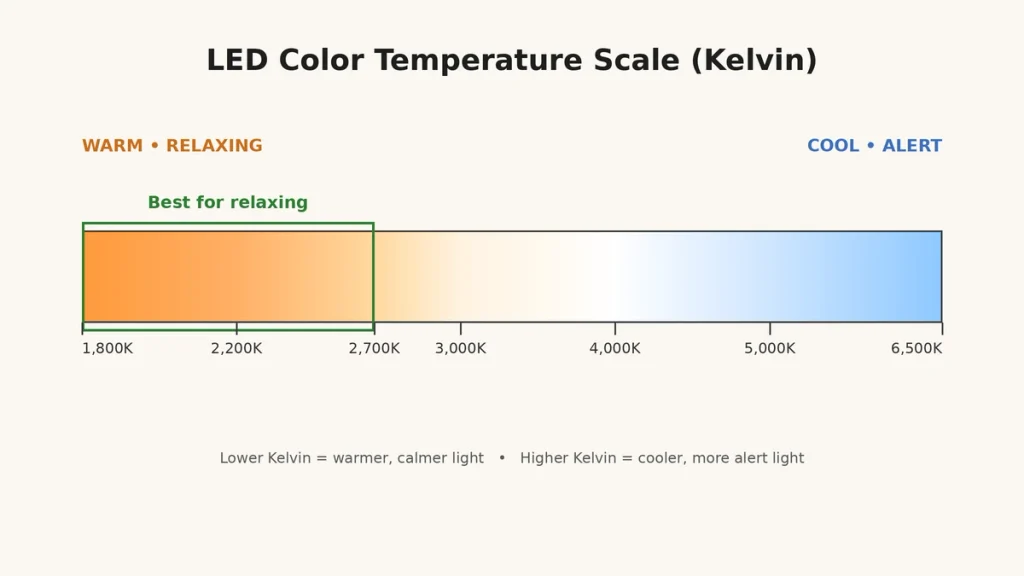
Here’s how the ranges break down in practice:
| Kelvin Range | Light Color | Best Used For |
|---|---|---|
| 1,800K – 2,200K | Candlelight, very warm amber | Bedside lamps, the last hour before sleep |
| 2,200K – 2,700K | Warm white | Living rooms, evening ambient lighting |
| 2,700K – 3,000K | Warm white to neutral | General relaxing spaces, reading corners |
| 3,500K – 4,000K | Neutral white | Not ideal for evenings, better for kitchens |
| 5,000K+ | Daylight, blue-rich | Avoid in relaxing spaces entirely |
A quick gut check: if the light looks anything like a candle or a sunset, you’re in the right zone. If it looks like a hospital hallway or an overcast afternoon, it’s not.
One thing brands rarely mention: color temperature only tells half the story. A 2,700K bulb blasting at full brightness can still feel too stimulating for winding down. Pair the right Kelvin rating with a dimmer, and the effect gets noticeably stronger.
Is red light or warm white better for relaxing?
Warm white works well for general relaxation in living rooms and shared spaces. Red and amber light work better when the goal is specifically to prepare for sleep.

Red sits at the far end of the visible spectrum, with the longest wavelength humans can see. That makes it the color with the least impact on your circadian rhythm out of any option, which is why it shows up so often in bedside lamps and sleep-focused LED strips.
Amber sits in between. It gives you a little more visibility and warmth than pure red without pulling in much blue content, which makes it a solid pick for living rooms where you still want to read or move around comfortably.
If you had to pick one rule: use warm white for the room, and save red or amber for the hour right before bed.
Should you use blue or green LED lights to relax?
No, not if relaxation and wind-down are the goal. Blue light is the single most stimulating color on the spectrum, and it’s the one you want to avoid after sunset.
Green sits closer to blue than most people assume, with a shorter wavelength than amber or red. In the Harvard study mentioned earlier, green light still suppressed melatonin, just less aggressively than blue.
There’s a common myth that colorful RGB lighting automatically creates a relaxing mood because it looks nice on camera. Looks and physiology are two different things. A soft blue or green glow might feel visually pleasant, but it’s not doing your nervous system any favors before bed.
Where should you use relaxing LED colors around your home?
Bedrooms and living rooms benefit the most from warm, low-Kelvin lighting, since these are the spaces where you’re actively trying to unwind.
Bedroom: Stick to 1,800K to 2,700K, ideally on a dimmer. Bedside lamps and under-cabinet LED strips work well here. Skip overhead lighting after sunset if you can help it.
Living room: 2,200K to 3,000K, layered across multiple sources instead of one bright overhead fixture. Lamps, LED strips behind furniture, and dimmable ceiling lights all work together better than one harsh source.
Bathroom: This one’s trickier because you need enough light to function. A 2,700K bulb on a dimmer switch, used at 30-40% brightness in the evening, keeps things usable without fully waking you up.
Home office or reading nook: If you use this space in the evening to decompress rather than work, drop down to 2,700K or lower once the sun goes down.
How to choose LED lights built for a relaxing atmosphere
Not every “warm white” bulb on a shelf actually performs the way the box claims. A few features separate the ones that work from the ones that don’t.
- Kelvin rating of 2,700K or lower. Check the packaging or product listing directly. Some manufacturers round up, so a bulb marketed as “warm” can still land closer to 3,500K.
- Dimmable, not just switchable. Brightness control matters almost as much as color. A dimmer lets you fine-tune the mood instead of choosing between “on” and “blinding.”
- CRI (Color Rendering Index) of 90 or higher. This affects how natural warm tones look. Cheaper LEDs with low CRI can produce a flat, slightly artificial warm color instead of a true candlelight glow.
- Smart app or remote control. Being able to switch from warm white during the evening to red at bedtime without getting up is genuinely useful, not just a gimmick.
- Flicker-free drivers. Budget LEDs sometimes flicker at a rate too fast to consciously notice but still tiring on your eyes. Look for products that specifically mention flicker-free operation.
Common mistakes people make with relaxing LED setups
Buying “warm white” without checking the actual Kelvin number. Marketing language isn’t standardized. Always check the spec, not just the label.
Running warm lights at full brightness. A 2,700K bulb at 100% output can still feel stimulating. Dim it down in the evening.
Using one overhead light instead of layered lighting. A single bright source overhead reads as “daytime” to your brain, no matter what color it is. Multiple smaller, warmer sources placed around the room feel more relaxing than one strong one.
Forgetting the morning. Warm, low-Kelvin light is great at night and genuinely bad in the morning, since it can delay your body’s natural wake-up signal. Save the warm tones for evening use.
The bottom line
Warm white and red-toned LEDs, somewhere between 1,800K and 2,700K, are the most reliable choice for a relaxing space. Dim them, layer them across a few sources instead of one, and save the cooler, brighter light for daytime.
FAQs
What Kelvin is best for relaxing LED lights?
Aim for 1,800K to 2,700K. The lower end of that range, closer to 1,800K, works best right before bed.
Is warm white or soft white better for relaxation?
They’re close, but warm white (2,700K to 3,000K) is generally slightly cozier than soft white (around 2,700K to 3,000K on some brands, though naming varies). Check the actual Kelvin number rather than relying on the label name.
Can red LED lights help you relax before bed?
Yes. Red light has the longest wavelength in the visible spectrum and the smallest impact on melatonin production, making it one of the most effective colors for winding down.
Should I avoid blue LED lights in the evening?
Yes. Blue light strongly suppresses melatonin and signals alertness to your brain, which works against relaxation, especially in the hour or two before bed.
Do dimmable LED lights matter for relaxation, or just the color?
Both matter. Color temperature sets the tone, but brightness controls intensity. A warm-colored bulb at full brightness can still feel too stimulating, so pairing the right Kelvin rating with a dimmer makes the biggest difference.