
|
Getting your Trinity Audio player ready... |
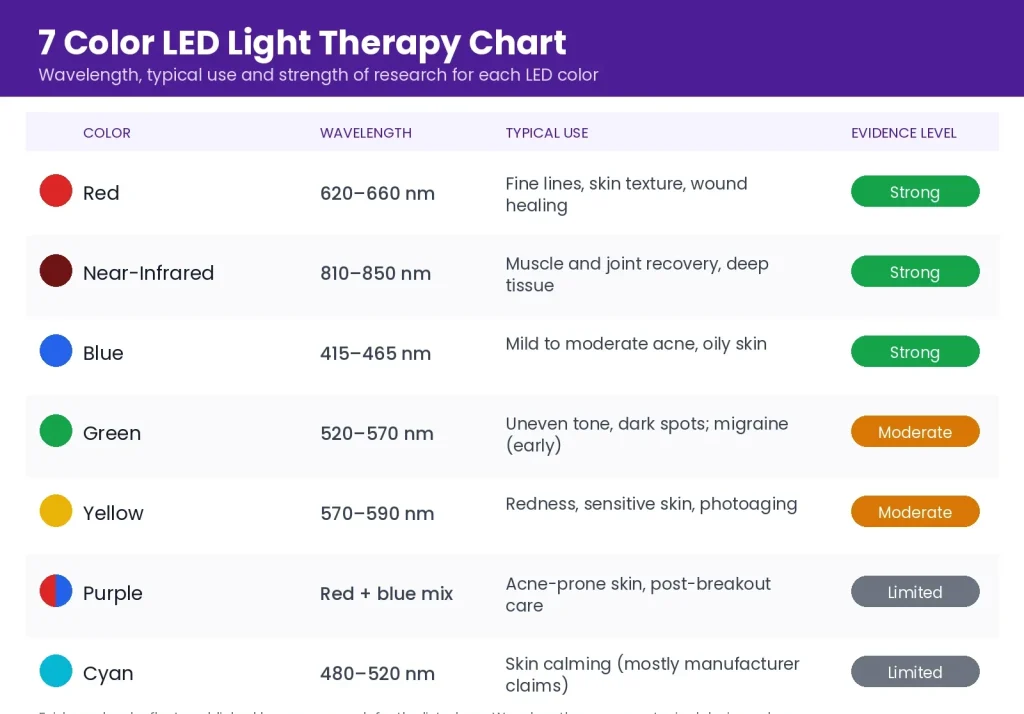
This 7 color LED light therapy chart compares typical wavelengths, common uses, and the available research for each color. Evidence varies by application and device: red, blue, and near-infrared have been studied for specific uses, while research on green, yellow, purple, and cyan is more limited.
Knowing this helps you separate the light therapy colors that are backed by studies from the ones that are mostly marketing.
LED light therapy color meanings describe the common uses associated with different wavelengths. Red light is studied for skin appearance, blue light for some acne treatments, and green light is often marketed for pigmentation, although evidence varies.
7 Color LED Light Therapy Chart: A Quick Summary
| Color | Wavelength (nm) | Typical use | Evidence level |
|---|---|---|---|
| Red | 620–660 nm | Fine lines, skin texture, wound healing | Strong |
| Near-infrared (NIR) | 810–850 nm | Muscle and joint recovery, deep tissue support | Strong |
| Blue | 415–465 nm | Mild to moderate acne, oily skin | Strong |
| Green | 520–570 nm | Uneven tone, dark spots; early work on migraine | Moderate |
| Yellow | 570–590 nm | Redness, sensitive skin, photoaging | Moderate |
| Purple | Red + blue mix | Acne-prone skin, post-breakout care | Limited |
| Cyan | 480–520 nm | Skin calming (mostly manufacturer claims) | Limited |
Evidence labels are a general guide, not a formal grading system. Research may support one use of a wavelength but not another, and results from multi-wavelength treatments do not establish the independent effect of each color. Even “strong” does not mean guaranteed results. Device power, session length and consistency matter as much as color.
Skin Layers and Light Penetration
LED light therapy is also called photobiomodulation. Specific wavelengths of visible and near-infrared light are absorbed by structures inside cells, mainly the mitochondria. That absorption can change cellular energy production and inflammatory signaling. LED light therapy does not rely on ultraviolet (UV) exposure, but device safety still depends on its output, intended use, and treatment instructions.
Wavelength decides where the light goes. Shorter wavelengths such as blue stay near the surface. Longer wavelengths such as red and near-infrared travel deeper. This is why color light therapy is matched to specific concerns instead of used all-purpose.
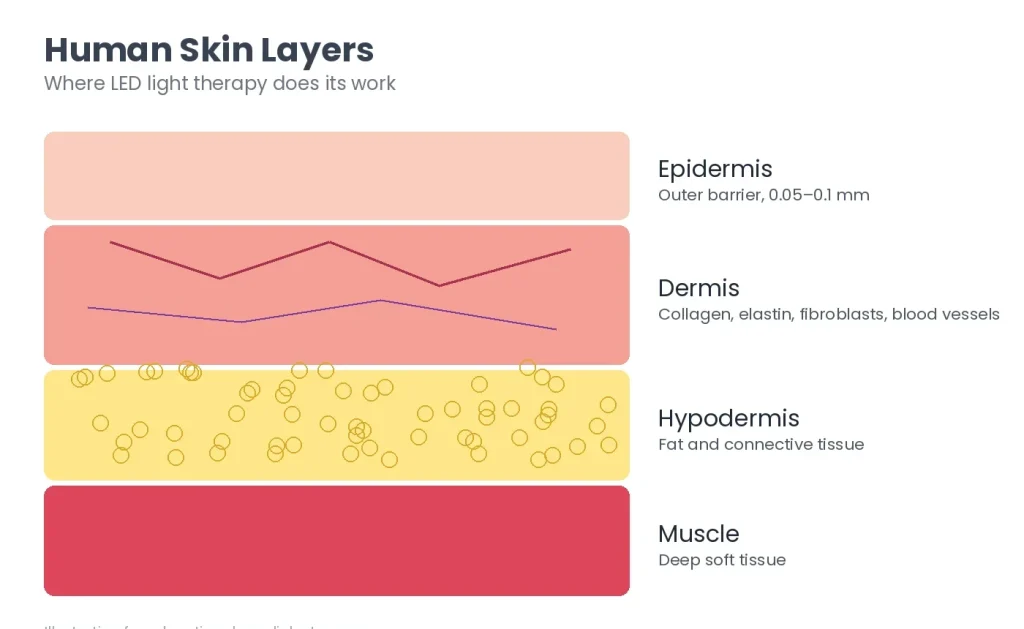
- Epidermis: the outer barrier. Oil glands open here, and acne bacteria live in the follicles.
- Dermis: the layer with collagen, elastin, fibroblasts and blood vessels. Most skin-aging research focuses here.
- Hypodermis: fat and connective tissue beneath the dermis.
- Muscle and deeper soft tissue: the target for recovery-focused devices.
How deep each color penetrates
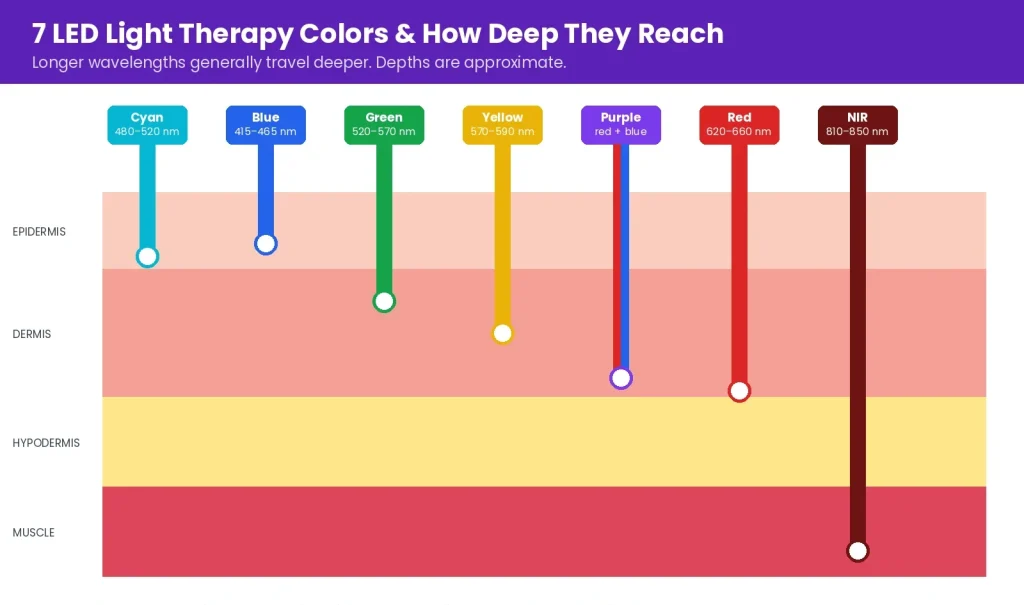
Depth is approximate and changes with device power, skin tone and distance from the skin. As a general guide, blue light tends to act closer to the skin’s surface, while red and near-infrared can reach deeper tissue. Actual penetration varies with wavelength, tissue characteristics, and device settings.
The 7 Colors Explained, One by One
Wondering how to use the LED colors for facials? It’s this simple. Just match the color to your concern using the colored light therapy chart. For a facial-specific look at how these colors are used, see our detatil guide to facial light therapy colors.
1. Red Light (620–660 nm)
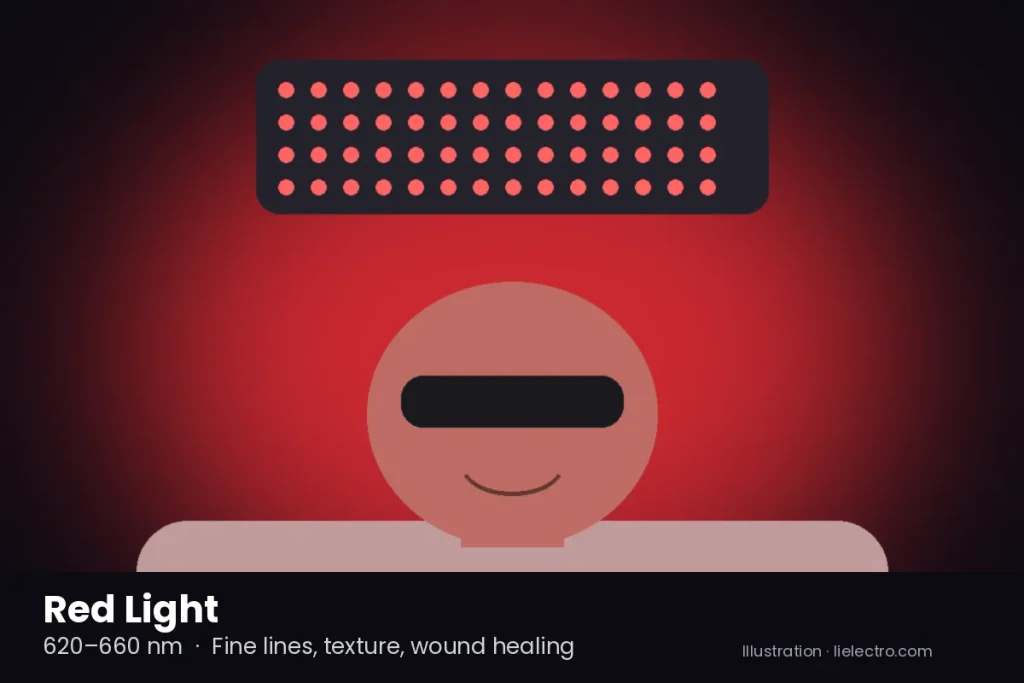
- Typical use: Skin texture and fine lines. Studied in human research; results vary by device and protocol.
- Penetration: dermis
- Evidence level: Strong
Red light is the most studied color for skin. In a controlled trial by Wunsch and Matuschka (2014), volunteers treated with red and near-infrared light reported better skin complexion and showed higher collagen density than controls. Research reviews have examined red-light photobiomodulation for skin-related applications, but outcomes vary by treatment protocol and indication. Results build over weeks, not days.
2. Near-Infrared Light (810–850 nm)
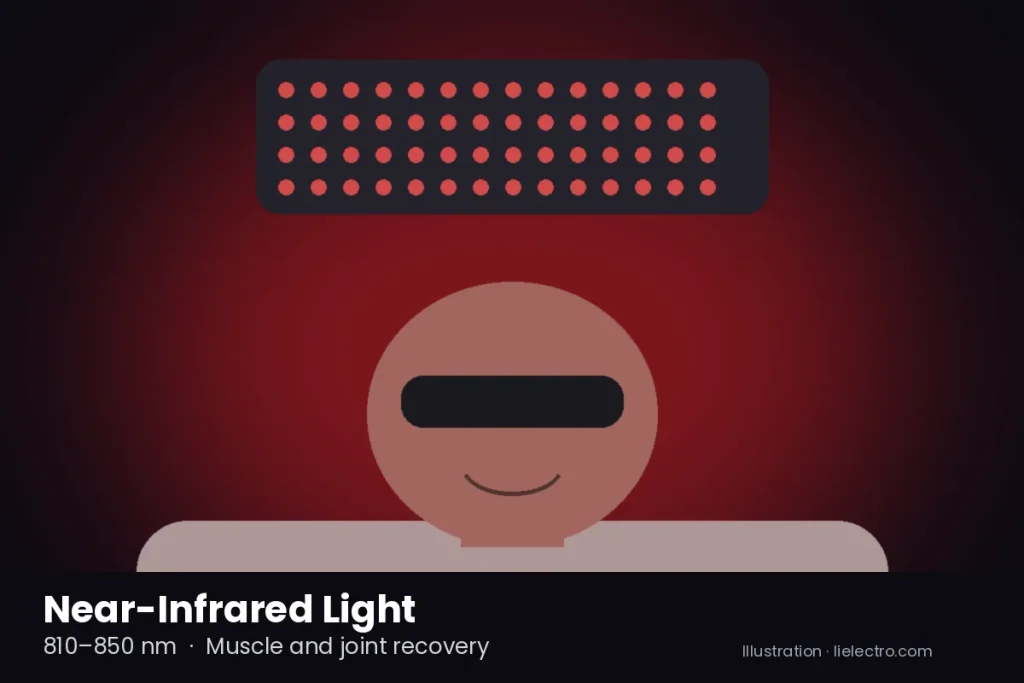
- Typical use: Selected tissue-recovery and pain-related applications. Studied in photobiomodulation research; evidence depends on the condition and protocol.
- Penetration: deep soft tissue
- Evidence level: Strong
Near-infrared light is invisible to the eye, so a device may look dim while it is working. Near-infrared light can penetrate deeper into tissue than many visible wavelengths, although the actual depth varies by tissue and device. Reviews have examined photobiomodulation for tissue-repair and pain-related applications. Evidence varies by condition, wavelength, dose, and treatment protocol.” Ensure the Hamblin reference supports the particular claims you retain.
3. Blue Light (415–465 nm)
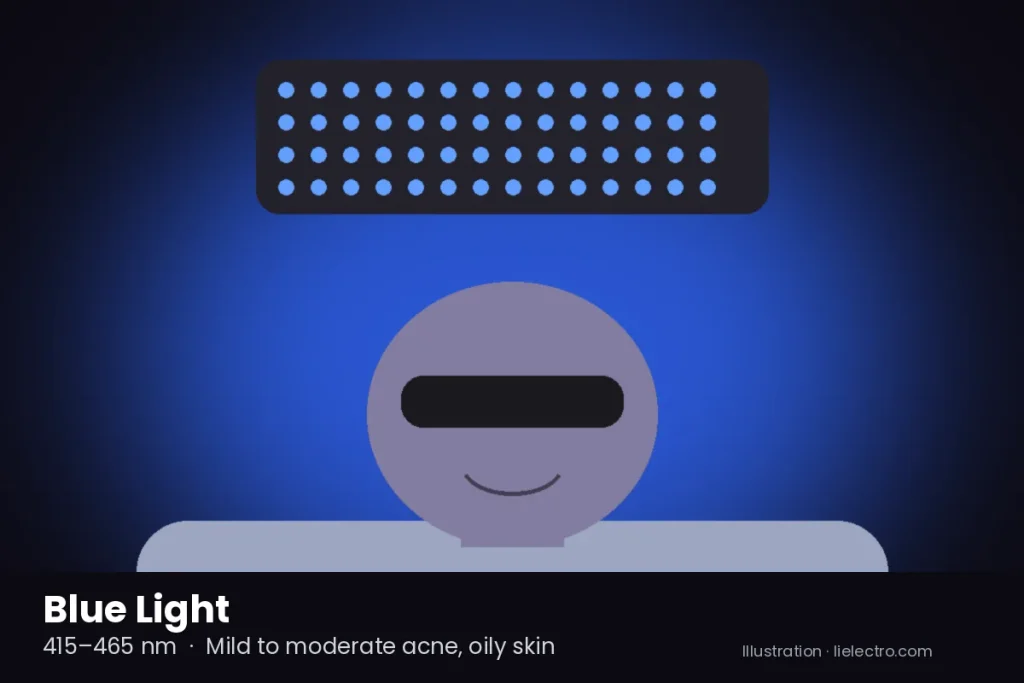
- Typical use: Some mild to moderate acne treatments. Clinical research supports potential benefits for certain acne applications.
- Penetration: epidermis
- Evidence level: Strong
Blue light acts on Cutibacterium acnes, the bacteria involved in acne. A 12-week trial (Papageorgiou et al., 2000) found that mixed blue and red light improved acne lesions, with the combination performing best among the light groups. Blue light is primarily studied for acne-related applications rather than as a treatment for wrinkles.
4. Green Light (520–570 nm)
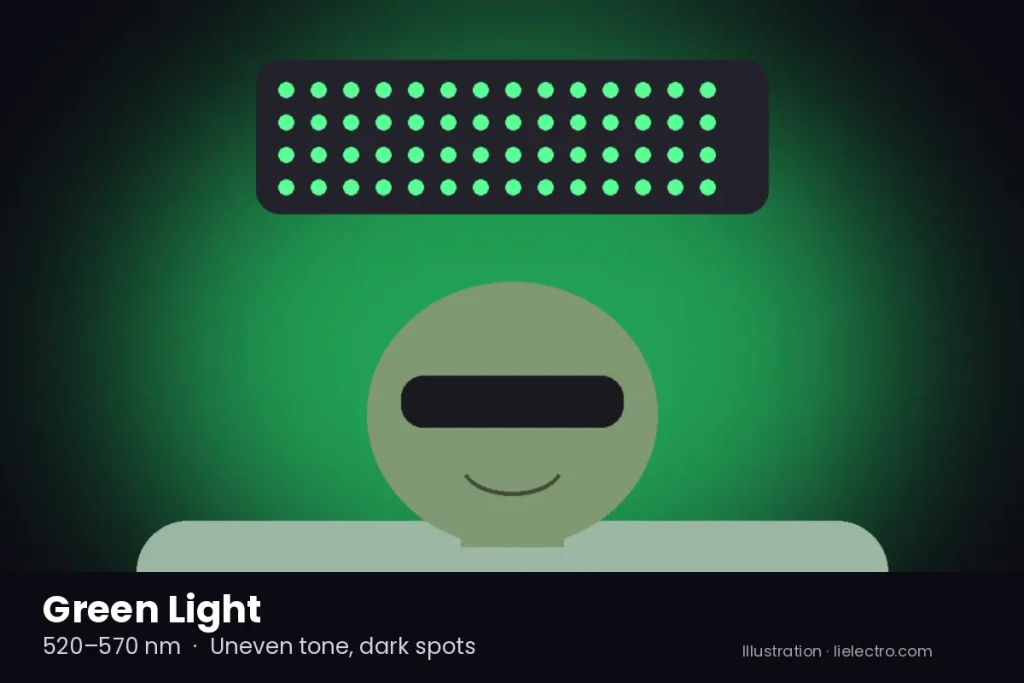
- Typical use: Often marketed for uneven tone and pigmentation. Limited evidence for specific skin outcomes.
- Penetration: epidermis to upper dermis
- Evidence level: Moderate
Green light is promoted for hyperpigmentation, but most support comes from laboratory work and small studies.A preliminary study examined green-light exposure for migraine. Ambient-light exposure is different from treatment with a green LED facial device, so the findings should not be used as evidence that a skincare device treats migraine. If dark spots are your main concern, treat green light as a supporting option alongside sun protection.
5. Yellow/ Amber Light (570–590 nm)
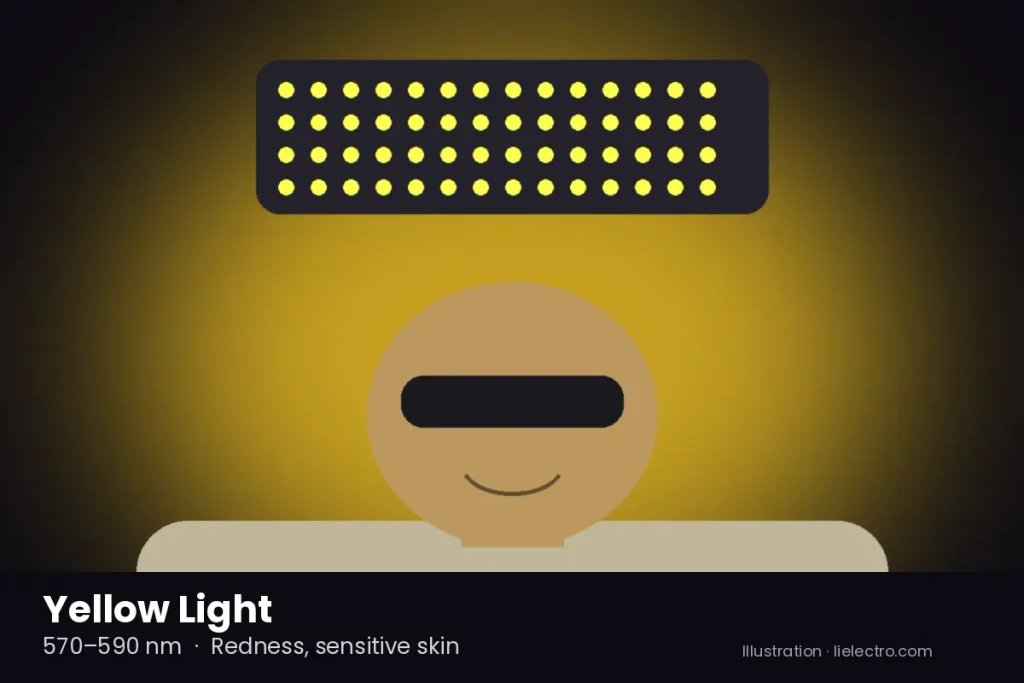
- Typical use: Oft
- en marketed for visible redness and skin appearance. Limited evidence for effects attributable to yellow light alone.
- Penetration: upper dermis
- Evidence level: Moderate
Yellow light is often called “amber.” Studies that include yellow usually combine it with red and near-infrared, so its separate effect is hard to isolate. Yellow light is often marketed for visible redness or sensitive-looking skin, but evidence for yellow light alone is limited. It should not be presented as a proven treatment for rosacea or another medical condition.
6. Purple Light (red + blue)
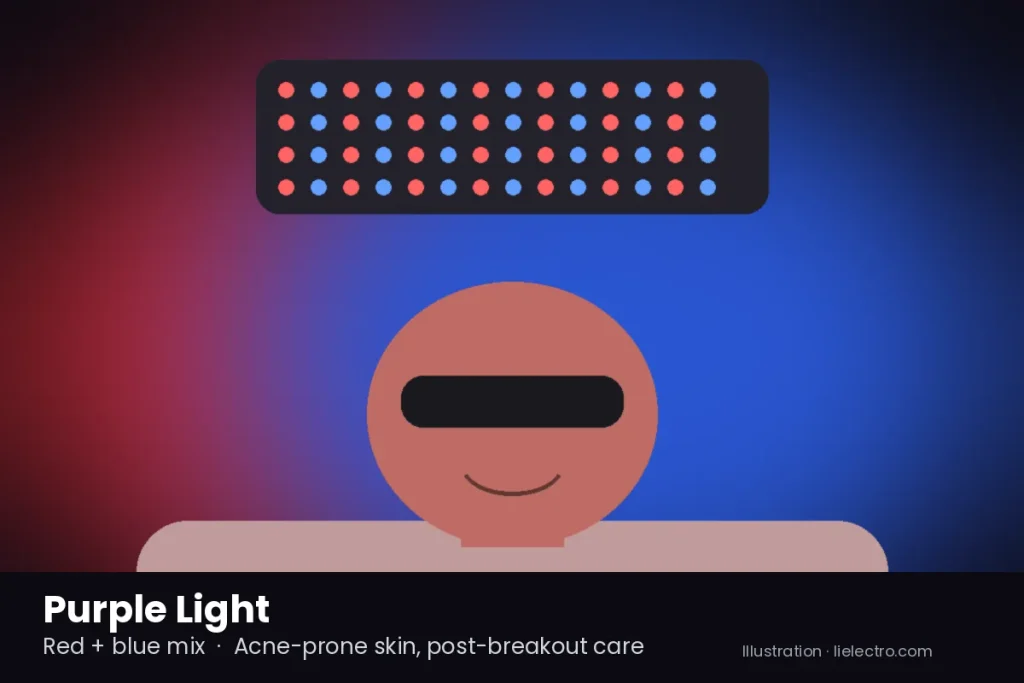
- Typical use: acne-prone skin, post-breakout care
- Penetration: varies with the wavelengths used
- Evidence level: Limited as a distinct therapy
Purple is not a separate wavelength. Devices make it by turning on red and blue LEDs together. Its benefits rest on the evidence for those two colors, and few studies test purple as a standalone treatment.
7. Cyan Light (480–520 nm)
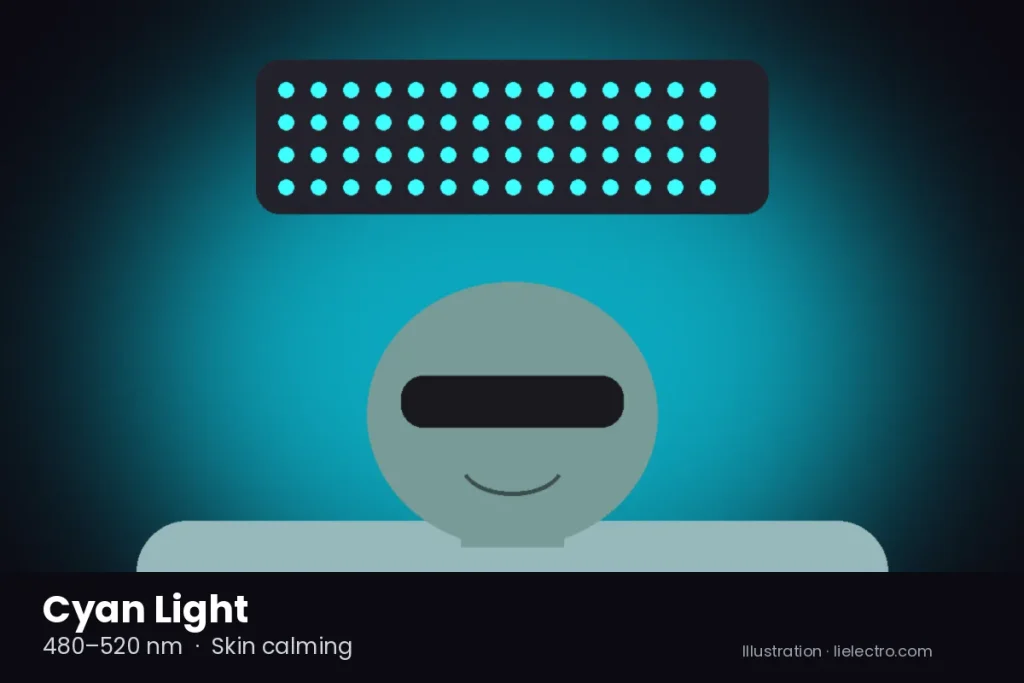
- Typical use: skin calming
- Penetration: epidermis
- Evidence level: Limited
Cyan light therapy sits between blue and green on the spectrum. Claims about calming and hydration come largely from manufacturers, and independent clinical research on cyan alone is thin. It is reasonable to try on a device that already includes it, but not a reason to pay extra.
How to Choose the Right Color
Match the color to one primary goal. A device with fewer, well-studied wavelengths often beats one that lists many colors. For detailed led lights therapy benefits, our comparison guide is worth consulting.
| If you want to… | Start with | Why |
|---|---|---|
| Soften fine lines and improve texture | Red | Most research for dermal collagen and skin quality |
| Ease muscle or joint soreness | Near-infrared | Reaches deeper tissue |
| Manage mild to moderate acne | Blue (or red + blue) | Targets acne bacteria; combined light has trial support |
| Even out skin tone | Green, with sun protection | Early evidence, supporting role |
| Calm visible redness | Yellow | Emerging evidence, often paired with red |
When comparing led colors for skin, check the stated wavelength in nm, not just the color name. A “red” LED outside the 620–660 nm range may not match the wavelengths used in studies.
Can You Combine Colors?
Yes. Many devices run two or more wavelengths at once, and common pairings have a logical basis.
- Red + near-infrared: skin renewal plus deeper tissue support
- Red + blue: acne-prone skin, where blue targets bacteria and red supports recovery
- Red + yellow: redness and photoaging
There is no proven best order. Follow the protocol that comes with your device, and stay consistent.
How to Use LED Light Therapy Safely
- Cleanse your skin and remove makeup first.
- Use the session time and distance from your device’s instructions. More is not better.
- Wear the eye protection supplied with the device, especially with bright blue or red panels. Never stare into the LEDs.
- Expect results after several weeks of regular use, not after one session.
- Check the device’s regulatory status and intended use where applicable. In the United States, FDA clearance and FDA approval are different terms; verify claims for the specific product.
Ask a qualified healthcare professional whether the device is suitable if you have a light-sensitive condition, an eye condition, a history of skin cancer, or take medication that increases photosensitivity. Follow any pregnancy-related warnings in the device instructions. Persistent skin problems should be assessed by a dermatologist.
What to Check Before Buying a Device
- Wavelengths listed in nm, not only color names.
- Irradiance (mW/cm²) and recommended session time.
- Coverage: masks for the face, panels and pads for larger areas.
- Clearance and testing: FDA clearance for the intended use, clear warranty and safety guidance.
- Realistic claims: be wary of promises of instant results or cures.
Disclosure: LiElectro may earn a commission from qualifying Amazon purchases at no extra cost to you. Editorial content is not influenced by commissions.
FAQ
What is the LED mask colors chart?
An LED mask colors chart is a quick reference that lists what each color on a mask does, usually with wavelengths. It is the same idea as the colored light therapy chart above. On most masks, red is used for fine lines and texture, blue for acne, near-infrared for deeper support, and green or yellow for tone and redness. Check that your mask lists wavelengths in nm.
Should I ask an esthetician which LED color to use?
An esthetician can help you choose a color for your skin type and goals, and can run professional-grade sessions in a clinic. For a medical concern such as persistent acne, rosacea or a changing mole, see a dermatologist instead. Bring your home device’s wavelengths to the appointment so the advice fits what you own.
Which face light therapy colors work best for beginners?
Red light is the usual starting point because it has the most research for skin quality. Add blue only if acne is your main concern.
Can you mix colors in one session?
Absolutely! Many LED face light therapy colors can be used in combo mode.
Is it safe for kids or teens?
Mostly yes, especially for acne-prone teens using blue light therapy. But always consult a dermatologist.
What color of LED helps with detoxification?
No LED color has been shown to detoxify the body. Your liver and kidneys do that job. Some brands link yellow light to “detox” or lymphatic drainage, but human studies don’t support it. Near-infrared and red light are studied for tissue recovery, which is a different claim.
What color light is best for inflammation?
Red and near-infrared light have the strongest research for calming inflammation. Reviews of photobiomodulation link them to lower inflammatory signaling and tissue repair. Near-infrared (810–850 nm) reaches deeper tissue, so it is often chosen for muscles and joints. Red (620–660 nm) is used for skin.
Why are we choosing 590 nm on the bar graph?
590 nm represents the standard clinical benchmark for yellow (amber) LED light therapy, sitting right in the middle of the yellow spectrum (570–620 nm). Manufacturers and charts highlight 590 nm because it is the most widely studied wavelength for calming surface redness, soothing sensitive skin, and boosting lymphatic circulation in the upper dermis.
Final Thoughts: Let Your Skin Glow from Within
Red, blue, and near-infrared light have been studied for specific applications, but the strength of evidence differs by use. A single ranking across all skin and tissue conditions can be misleading. Red is the usual starting point for fine lines and skin texture, near-infrared for muscle and joint recovery, and blue for mild to moderate acne.
Green and yellow show promise for uneven tone and redness, but the research is still early. Purple is simply red and blue used together, and cyan has little independent research behind it.
When you choose a device, match the wavelength in nm to one main goal. Then check the irradiance and look for FDA clearance for its intended use. Expect gradual changes over several weeks of regular sessions, not overnight results.
If you have a persistent skin condition, are pregnant, or take medication that makes you sensitive to light, check with a doctor or dermatologist before you start.
Leave a Reply