
|
Getting your Trinity Audio player ready... |
What do the different LED light therapy colors mean, and which ones are commonly used for skin concerns? LED light therapy uses specific wavelengths of light for skincare applications, with red and blue light among the most widely studied options.
Understanding LED light therapy color meanings can help you compare devices, recognize common uses and evaluate product claims. However, a color alone does not guarantee a particular result. Wavelength, light output, treatment duration and device design all influence how a treatment works.
This guide explains the main LED light colors for skin, what each setting is commonly used for, and how to choose a device based on its specifications and supporting evidence.
Quick summary
LED light therapy colors are different light settings, each tied to a range of wavelengths. Red is studied for skin texture and fine lines. Blue is used for acne-prone skin. Green, yellow, purple and white have more limited or device-specific evidence, and near-infrared sits beyond visible light. Color names aren’t standardized, so check a device’s listed wavelengths before you compare or buy.
What Do LED Light Therapy Colors Mean?
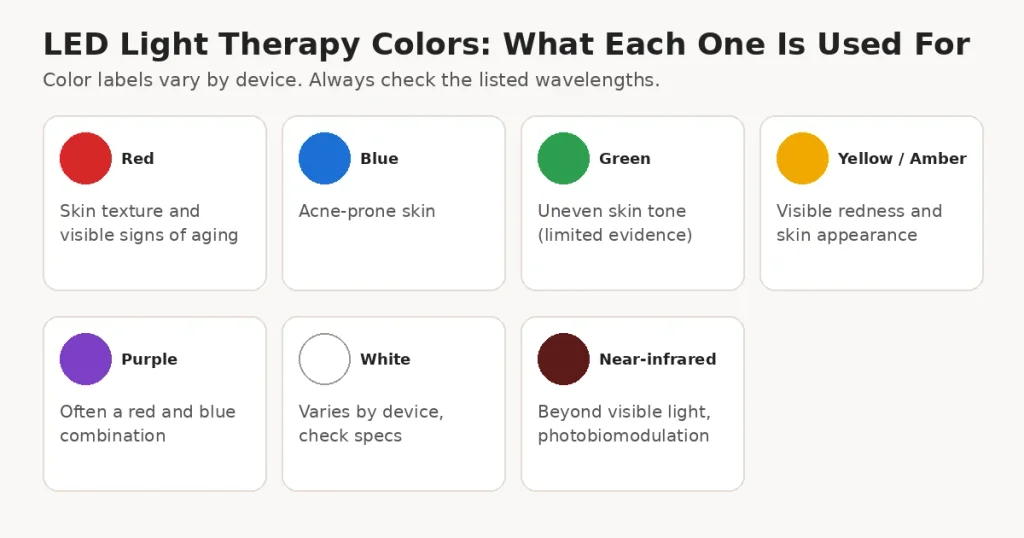
LED light therapy colors refer to the visible colors produced by light-emitting diodes (LEDs). Each visible color corresponds to a range of wavelengths, measured in nanometers (nm), which influence how light interacts with the skin.
| Color | Commonly used for | Evidence note |
|---|---|---|
| Red | Skin texture, visible signs of aging | Studied; results depend on device and protocol |
| Blue | Acne-prone skin | Some support; not a guaranteed fix for severe, cystic or hormonal acne |
| Green | Uneven skin tone, dark spots | Limited |
| Yellow / Amber | Visible redness, general appearance | Varies by wavelength and device |
| Purple | Often a red and blue combination | Depends on the wavelengths the device actually emits |
| White | Varies by device | Check specifications; household light isn’t a therapy device |
| Near-infrared | Photobiomodulation | Depends on wavelength, dose and intended use |
Different light therapy colors are marketed for different skincare concerns, but the strength of the evidence varies. Two devices with the same color setting may also use different wavelengths or light outputs.
Red Light: Skin Texture and Visible Signs of Aging
Red LED light has been studied for its potential role in skin rejuvenation and tissue recovery. Some research suggests that specific red-light treatments may improve the appearance of fine lines and skin texture.
Results depend on the device and treatment protocol. Red light is not a guaranteed anti-aging treatment, and claims about collagen production or skin repair should be assessed against evidence for the specific device.
Blue Light: Acne-Prone Skin
Blue LED light is commonly used in devices designed for acne-prone skin. Certain blue wavelengths can affect Cutibacterium acnes, a bacterium associated with acne.
Research supports potential benefits for some forms of acne, although outcomes vary. Blue light should not be considered a guaranteed treatment for severe, cystic or hormonal acne.
Green Light: Uneven Skin Tone
Green LED light is often marketed for uneven skin tone and the appearance of dark spots. However, evidence supporting green LED devices for pigmentation concerns remains limited.
Do not assume that every green-light device can fade dark spots. Sun protection and an appropriate skincare routine remain important when managing uneven pigmentation.
Yellow or Amber Light: Redness and Skin Appearance
Yellow and amber LED settings are marketed for visible redness and general skin rejuvenation. Evidence varies depending on the wavelength, device and intended application.
Persistent facial redness can have several causes. If you suspect rosacea or another skin condition, seek advice from a qualified healthcare professional rather than relying on an LED color alone.
Purple Light: A Red-and-Blue Combination
Purple LED settings often combine red and blue light rather than representing one standardized therapeutic wavelength. The intended application depends on the wavelengths the device actually emits.
Blue and red light have been studied for certain acne-related applications, including their use together. However, not every device labelled “purple” delivers the same combination or produces the same results.
For the evidence and practical considerations, read our guide to Purple LED Light Therapy Benefits: Acne, Skin & Evidence.
White Light: Check the Device Specifications
White LED light does not represent one universal therapeutic wavelength. White LEDs can produce a broad spectrum of visible light, and their composition varies by device.
Claims that white LED light automatically penetrates deeper, increases collagen or improves multiple skin concerns should be evaluated against evidence for the specific device and application. Ordinary white household lighting is not equivalent to a tested facial LED therapy device.
Near-Infrared Light: Beyond the Visible Spectrum
Near-infrared (NIR) light lies beyond the visible red portion of the spectrum. Some devices use specific near-infrared wavelengths for photobiomodulation, which studies how certain light exposures affect biological processes.
Unlike visible red light, near-infrared light cannot be seen as an ordinary color. Its potential effects depend on the wavelength, dose, device and intended use.
How to Choose Between Different LED Light Colors for Skin
When comparing LED light colors for skin, begin with your main concern and the device’s intended use. Color labels can help you navigate the options, but they should not replace a review of the product specifications.
- Acne-prone skin: Consider devices designed for acne that specify their blue-light wavelengths and intended use.
- Visible signs of aging: Look for evidence relating to the device’s red-light wavelength and the skin concern you want to address.
- Uneven skin tone: Be cautious about claims that green light reliably treats pigmentation.
- Combination settings: Purple may combine red and blue light, so check the actual wavelengths rather than relying on the color name.
- White or near-infrared settings: Review the manufacturer’s specifications and evidence for the intended application.
A device offering more colors is not automatically more effective. Choose based on the treatment goal, device design, safety instructions and evidence supporting its intended use.
What Is the Difference Between LED Light Therapy Colors?
The main differences are wavelength, how light interacts with the skin and the applications studied for each setting. Red and blue light have been investigated for particular skincare uses, while evidence for some other colors is more limited or device-specific.
Color names are not standardized treatment specifications. A purple setting may combine red and blue LEDs, while white settings can vary in spectral composition. Household lighting and bright-light therapy lamps also serve different purposes from facial LED treatment devices.
For a detailed comparison of wavelengths, common uses and evidence strength, see our 7 Color LED Light Therapy Chart: Wavelengths & Uses.
How to Choose an LED Light Therapy Device
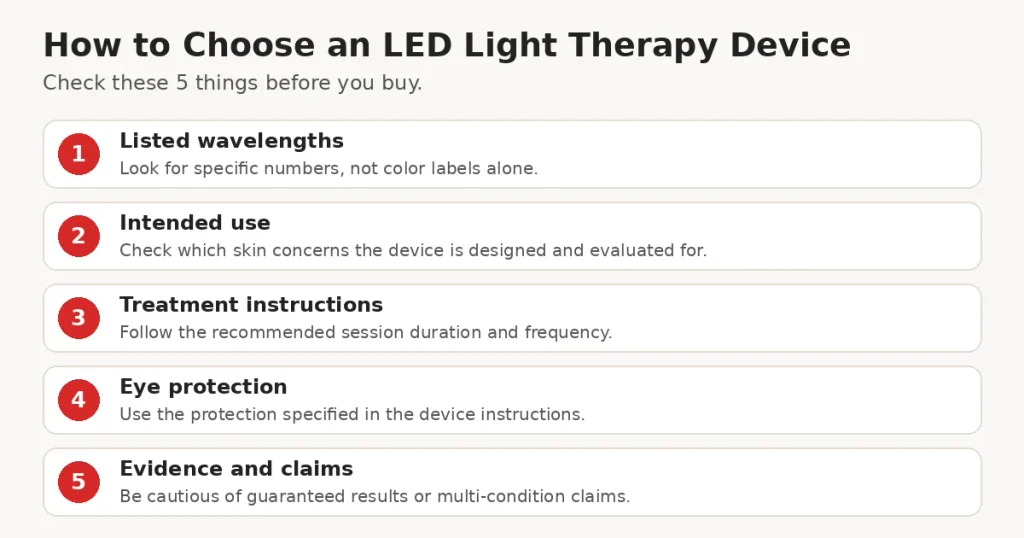
Before buying an LED skincare device, check these details:
- Listed wavelengths: Look for specific wavelength information rather than color labels alone.
- Intended use: Check which skin concerns the device is designed and evaluated to address.
- Treatment instructions: Follow the manufacturer’s recommended session duration and frequency.
- Eye protection: Use the protection specified in the device instructions.
- Evidence and claims: Be cautious of guaranteed results or claims that a device treats multiple conditions without supporting evidence.
If you want to compare the potential uses of different colors, read 8 Best LED Light Therapy Color Benefits. For a guide focused specifically on facial masks and their settings, see Facial Light Therapy Colors: What Each Color Is Used For.
Is LED Light Therapy Safe?
LED light therapy is generally considered low risk when an appropriate device is used according to its instructions, but side effects can occur. These may include temporary irritation, dryness, discomfort or eye-related symptoms.
Follow the manufacturer’s guidance on treatment time, frequency and eye protection. Ask a healthcare professional before using a device if you have a light-sensitive condition, take medication that can increase photosensitivity, or have a skin concern that needs medical assessment.
Stop using the device if you experience persistent irritation, pain or changes in pigmentation.
For practical guidance on treatment frequency and session duration, read How Often Should I Use LED Light Therapy at Home.
Final Thoughts
Understanding LED light therapy color meanings is a useful first step when comparing skincare devices. Red, blue, green, yellow, purple, white and near-infrared settings differ in their wavelengths, intended applications and supporting evidence.
Rather than choosing a device by color alone, check its specifications, intended use and safety instructions. Use our LED color chart for detailed wavelength comparisons, and explore the relevant color-benefit and facial-treatment guides for more specific information.
FAQs
Are LED light colors for skin equally effective?
No. Evidence varies by wavelength, skin concern, device and treatment protocol. A color’s popularity or presence on a multi-color mask does not prove that it is effective for every advertised use.
Does every LED face mask use the same color meanings?
No. Different masks may use different wavelengths, combinations and light outputs. A setting labelled purple or white may not be equivalent across manufacturers. Check the product specifications before comparing devices.
Which color of LED light therapy is most effective?
Blue light is commonly used for acne, while red light is studied for fine lines and skin texture. The most effective color depends on your skin concern and the device’s wavelength.
Leave a Reply