
|
Getting your Trinity Audio player ready... |
Purple LED light therapy usually combines blue and red light. Research on these wavelengths includes some acne and skin-related applications, but evidence for a purple setting itself is limited. Claims about dark spots, fine lines, and lymphatic drainage need particular caution.
This guide reviews the available evidence, common claims, and safety considerations before you choose or use a purple LED device.
Most studies tested blue and red light, not “purple” as a product setting. That gap matters, so the evidence section spells it out.
Quick overview
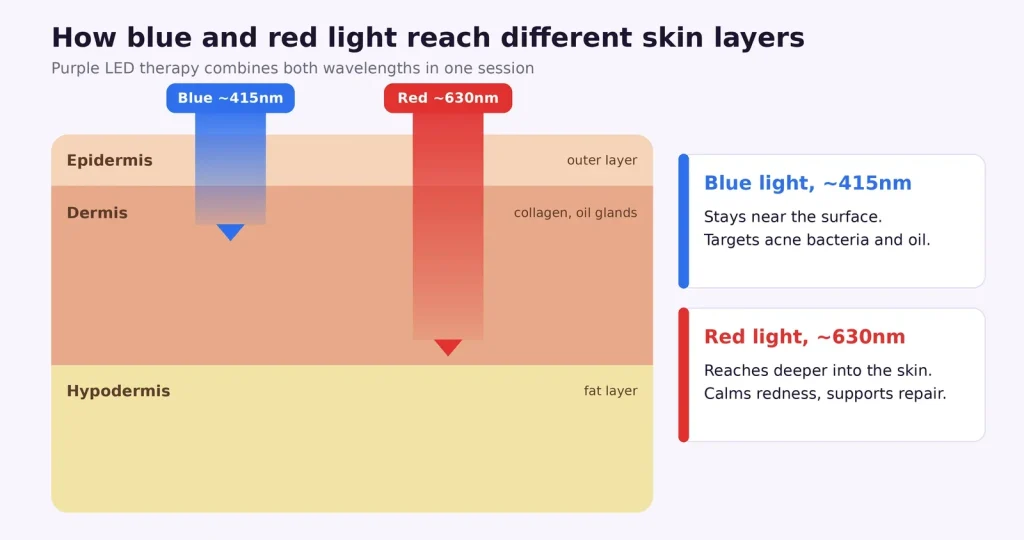
Purple LED light therapy benefits come from 2 wavelengths used together: blue (~415nm) and red (~630nm). Exact wavelengths vary by device.
- Most relevant evidence: certain acne treatments using blue and red light; evidence for redness varies.
- Thinner evidence: dark spots, fine lines, texture
- Typical use: Typical use varies by device. Follow the manufacturer’s specified session duration and frequency.
- Typical timeline: Results and timelines vary by device and skin concern. Do not treat these timeframes as guaranteed outcomes
- No solid evidence: lymphatic drainage, brain or mood effects
- Buy: an FDA-cleared device with listed wavelengths
What Do Purple Led Lights Mean and How Does It Work?
Purple LED light therapy is a skin treatment that shines blue light (~415nm) and red light (~630nm) on your face at the same time. Many devices label the mix as a single “purple” mode. For a general overview, see our guide to led light therapy color meaning.
Each color does a different job:
- Blue light can activate light-sensitive compounds produced by Cutibacterium acnes in laboratory settings. This helps explain why blue light is studied for acne, although laboratory findings do not guarantee clinical results.
- Red light penetrates differently from blue light and has been studied for some skin-related applications. Its effects depend on wavelength, dose, and treatment protocol.
The combination is intended to use the different properties of blue and red light, but the effect of a specific purple device depends on its wavelengths and treatment settings.
Device makers call this photobiomodulation or low-level light therapy. Many home LED devices are non-invasive, but irritation and other side effects can still occur. Follow the device instructions and stop if you experience a concerning reaction.
Purple LED light therapy benefits for skin
Purple LED devices are commonly marketed for acne and redness. Evidence for these outcomes largely comes from studies of red and blue light or other light-based treatments, rather than purple settings tested directly. You can quickly comapre different led light colors, if needed.
Purple LED light therapy benefits for acne
Blue and red light combinations have been studied for mild to moderate acne. However, evidence for a particular purple LED device depends on its wavelengths, output, and treatment protocol.
A trial by Papageorgiou et al. (2000) investigated blue and red light for acne and reported improvements in inflammatory lesions. Verify the participant count, treatment schedule, and percentage reduction against the original paper before retaining specific numbers.
Here’s what that means in practice:
- Inflamed pimples: blue and red light have been studied in acne treatments, but the outcome depends on the device and treatment protocol.
- Whiteheads and clogged pores: some makers claim less oil and fewer clogged pores. The evidence there is thin.
- Cystic or scarring acne: LED alone probably won’t be enough. See a dermatologist.
- Timeline: Assess results according to the manufacturer’s recommended treatment period. Improvement is not guaranteed, and persistent acne may need medical treatment.
Treat it as an add-on to your routine. Severe acne still needs prescription care.
Redness and irritation
Purple devices combine red and blue light, but evidence does not establish that every purple setting is suitable for irritated or redness-prone skin.
If you have rosacea, ask your dermatologist first. Some people with rosacea flush from the warmth of a device.
Healing after procedures
Some clinics use LED treatments alongside cosmetic procedures, but evidence and protocols vary. Ask your treating clinician before applying a home device to skin recovering from a peel, microneedling, or laser treatment.
Ask your provider before using a home device on freshly treated skin.
Dark spots and skin tone
Some trials report a better complexion with red light. Evidence for fading dark spots is limited.
Sun protection matters more for pigmentation than any light device does. If dark spots are your main concern, start with daily SPF.
Fine lines and texture
Wunsch and Matuschka (2014) studied red and near-infrared light for skin appearance. Because near-infrared is not the same as the blue-and-red combination in many purple devices, these results should not be presented as direct evidence for purple light.
A purple device may not include near-infrared light. Results from red-plus-near-infrared studies therefore cannot be assumed to apply to a red-and-blue device.
Does purple light therapy help with lymphatic drainage?
There is no good evidence that purple LED facial devices improve lymphatic drainage.
Research on light and lymph flow does exist. It studies red and near-infrared low-level laser for lymphedema, the swelling that can follow cancer surgery. That’s a different light, a different condition and a different dose, delivered in clinical settings.
For temporary morning puffiness, you could try simple measures such as:
- Enough sleep
- Less salt
- A cold compress in the morning
- Gentle facial massage
If a brand says its purple mask “drains” your lymph, ask to see the study.
What does the evidence say?
The evidence is strongest for mild to moderate acne and redness, thinner for dark spots and wrinkles, and close to nonexistent for lymphatic drainage. Few trials test a “purple” setting directly. Most test blue and red.
| Benefit | Strength of evidence | What was tested |
|---|---|---|
| Mild to moderate acne | Moderate | Blue + red light, 12-week trial |
| Killing acne bacteria | Strong (lab) | Blue light on C. acnes |
| Redness and inflammation | Limited to moderate | Reviews of low-level light therapy |
| Fine lines and texture | Limited to moderate | Red + near-infrared light |
| Dark spots | Limited | Small studies |
| Lymphatic drainage (face) | Very limited | Lymphedema research, not purple light |
| Brain or mood effects | None for facial devices | Nothing relevant |
Key sources, in plain terms:
- Papageorgiou et al., 2000, British Journal of Dermatology: mixed blue and red light improved inflamed acne more than blue or white light.
- Ashkenazi et al., 2003: a lab study showing blue light damages acne bacteria through their own porphyrins.
- Avci et al., 2013, Seminars in Cutaneous Medicine and Surgery: a review finding low-level light therapy can support skin healing and rejuvenation, and calling for better-standardized trials.
- Wunsch & Matuschka, 2014, Photomedicine and Laser Surgery: red plus near-infrared light improved wrinkles, roughness and collagen density.
What we don’t know:
- Whether a “purple” mix beats using blue and red separately
- How device power differences change results (they vary a lot)
- How well results hold for darker skin tones, since many trials include few participants with them
- Long-term results past a few months
Purple light therapy before and after: how long until you see results?
Purple LED before-and-after results vary. Studies of blue and red light use specific devices and treatment schedules, so their results cannot guarantee the same timeline for a home purple-light mask.
- Redness and oil: around 2 to 4 weeks
- Acne: 8 to 12 weeks
- Texture and fine lines: 12 weeks or longer
These are typical ranges from trials and device guidance, not promises. If nothing has changed by 12 weeks of consistent use, move on.
How to use purple LED light therapy on your skin
Who it suits and all skin tones
Purple LED devices are marketed for acne-prone skin, but suitability depends on the device, its wavelengths, and your skin’s condition
LED devices designed for therapy do not rely on UV light, but safety depends on the device and individual circumstances. Research in darker skin tones may be limited. Follow the manufacturer’s guidance and stop use if you notice irritation or changes in pigmentation.
How often and how long
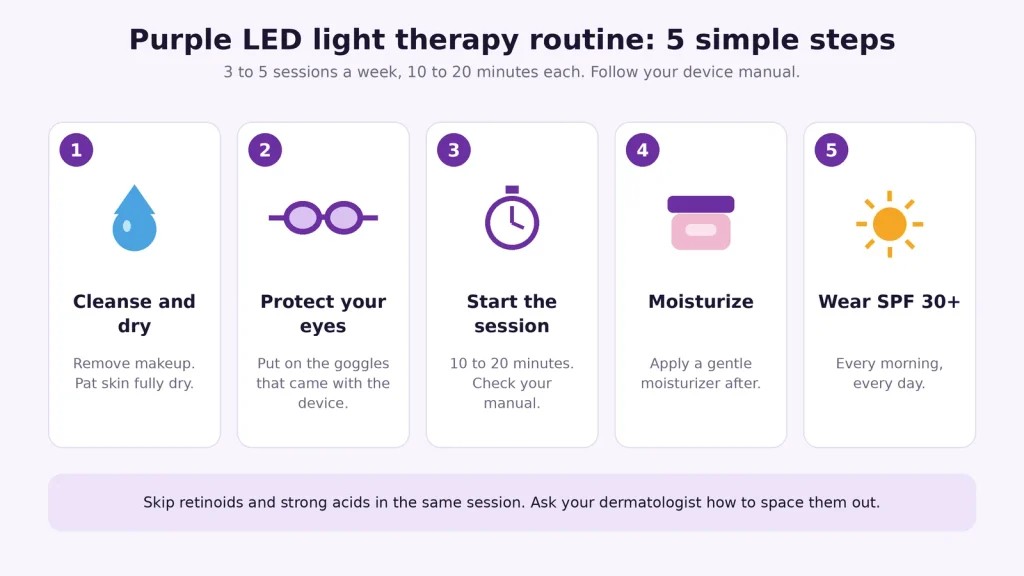
Session frequency and duration differ between devices. Follow the instructions for your specific model rather than using a general schedule. Follow your device’s manual, since power varies.
Simple routine
- Remove makeup and cleanse. Dry your skin.
- Put on eye protection.
- Use the device as the manual says, 10 to 20 minutes.
- Apply moisturizer.
- Wear SPF 30+ in the daytime, as the American Academy of Dermatology advises.
If your skincare products cause irritation or you use prescription acne treatments, ask a dermatologist or pharmacist whether you need to adjust your routine before using the device.
Choosing a device
- Check any FDA claims against the specific device and intended use. Registration alone does not mean a device has been cleared or approved for effectiveness.
- Listed wavelengths: look for ~415nm blue and ~630 to 660nm red.
- Adjustable intensity and included eye protection.
- Real LEDs: decorative purple bulbs don’t deliver therapeutic wavelengths or doses.

LED Face Tool with Purple Light
This magic face mask makes you beautiful every day.
Buy from AmazonAt-home masks and wands are lower power but cost less per session over time. Dermatologists and med spas use stronger devices and charge per visit.
Safety and who should check with a doctor first
Side effects are usually mild: temporary redness, dryness, eye strain or headache.
Ask a doctor first if you:
- Are pregnant
- Have a light-sensitive condition like lupus
- Have a history of skin cancer
- Take photosensitizing medication, such as isotretinoin or doxycycline
This article is for information only and isn’t medical advice.
How does purple compare to other LED colors?
Purple light is more than just a pretty color on the LED spectrum. It holds a powerful position in the LED light therapy color chart.
| Color | Typical wavelength | Depth | Best known for |
|---|---|---|---|
| Purple | ~415nm + ~630nm | Shallow + deep | Acne with redness |
| Red | 630 to 660nm | Deeper | Redness, healing, fine lines |
| Blue | ~415nm | Shallow | Active breakouts |
| Green | ~520 to 530nm | Shallow | Tone claims (limited evidence) |
Choose a device according to your main concern and its stated wavelengths. Blue and red light have been studied for certain acne applications; red light has also been studied for skin appearance. Evidence for a purple setting depends on the device and combination.
Conclusion
Purple LED devices combine red and blue light, but evidence for purple settings themselves remains limited. Research on the individual wavelengths may be relevant, but does not guarantee the same results from every device. Choose a device with clear wavelength specifications and credible safety information, and follow its recommended treatment schedule. Results vary and are not guaranteed.
Talk to a dermatologist first if you’re on acne medication or have a skin condition.
Sources
- Papageorgiou P, Katsambas A, Chu A. British Journal of Dermatology, 2000
- Ashkenazi H, et al. FEMS Immunology & Medical Microbiology, 2003
- Avci P, et al. Seminars in Cutaneous Medicine and Surgery, 2013
- Wunsch A, Matuschka K. Photomedicine and Laser Surgery, 2014
- American Academy of Dermatology: sunscreen guidance
Frequently Asked Questions (FAQs)
Can purple light help with hormonal acne?
Blue and red light have been studied for some acne treatments, but evidence does not establish purple LED therapy as an effective treatment for hormonal or cystic acne. Consult a dermatologist for persistent, painful, or scarring acne.
How long until I see results?
The time needed to see results varies by device, treatment schedule, and skin concern. Improvement is not guaranteed; follow the manufacturer’s instructions.
Does it work on darker skin tones?
Safety and effectiveness data may be limited for some skin tones. Suitability depends on the device and individual circumstances, so follow its safety guidance and seek professional advice if concerned.
Can purple light be used on the body, not just the face?
Some LED devices are designed for body use, but effectiveness depends on the device, treatment area, and intended use. Do not assume a facial mask is suitable for the scalp or other body areas.
Will it help with old acne scars or hyperpigmentation?
Evidence that purple LED therapy fades old acne scars or hyperpigmentation is limited. Do not assume it produces results comparable to microdermabrasion or other dermatological treatments.
Is purple light better than red light therapy?
It depends on your goal. Purple combines blue and red, so it suits acne with redness. Red alone has more research behind it for fine lines and recovery. Neither is better for everyone.
Can you use purple light therapy every day?
Recommended frequency varies by device. Follow the instructions for your specific model; using it more often does not necessarily improve results. More sessions haven’t been shown to give better results. Follow the manufacturer’s limits.
Leave a Reply