
|
Getting your Trinity Audio player ready... |
To dim LED lights safely, pair dimmable LED bulbs with an LED-compatible trailing-edge (ELV) wall dimmer switch, an inline or plug-in PWM dimmer, Wi-Fi/Matter smart LED bulbs, or 3-way dimmable LED bulbs. Unlike incandescent filaments that dim when supply voltage drops, LEDs rely on internal electronic drivers that regulate brightness by chopping AC waveforms or modulating DC pulse width.
Quick Overview: Choosing the Right LED Dimming Method
- Hardwired Ceiling & Recessed Lights: Install a trailing-edge (ELV) or universal LED wall dimmer switch for smooth 1%–100% wall control.
- Table Lamps & 12V/24V LED Strips: Connect a plug-in lamp dimmer or low-voltage DC inline PWM dimmer with zero wall wiring.
- No-Rewiring Ceiling & Lamp Control: Screw in smart LED bulbs (Wi-Fi, Zigbee, or Matter) on a standard ON/OFF switch for app and voice dimming.
- Preset Lamp Brightness (No Hardware): Use a 3-way dimmable LED bulb inside a 3-way lamp socket to cycle between 30%, 60%, and 100% output.
Before modifying any fixture, confirm that your bulbs are rated for dimming. Applying reduced power to a non-dimmable constant-current driver stresses internal capacitors and shortens bulb lifespan, see Are LED Lights Dimmable? to verify your hardware first.
Verify That Your LED Bulbs Are Dimmable
Every dimmable LED light requires an internal driver designed to interpret external phase-cut or low-voltage control signals. Check these three indicators before selecting a dimming method:
- Bulb Base Stamp: Look for the word “Dimmable” or a standard dimmer symbol printed on the heat-sink collar above the screw base.
- Packaging & Spec Sheet: Confirm explicit “Dimmable” labeling alongside compatible control standards.
- Driver Protocol Match: Commercial and architectural fixtures rely on specific dimming protocols, TRIAC (leading-edge), ELV (trailing-edge), or 0–10V. Consult Dimmable LED Light Meaning & Types to match your fixture’s driver architecture with the right control device.
How to Dim LED Lights Using a Dedicated Dimmer Control
When you want tactile, physical brightness adjustment via a wall plate, lamp cord, or strip controller, use one of these two hardware dimmer setups:
Method 1: Install a Hardwired LED Wall Dimmer Switch (Ceiling & Recessed Lights)
Replacing a standard toggle switch with an LED-rated wall dimmer provides permanent, full-range dimming for chandeliers, flush mounts, and recessed cans.
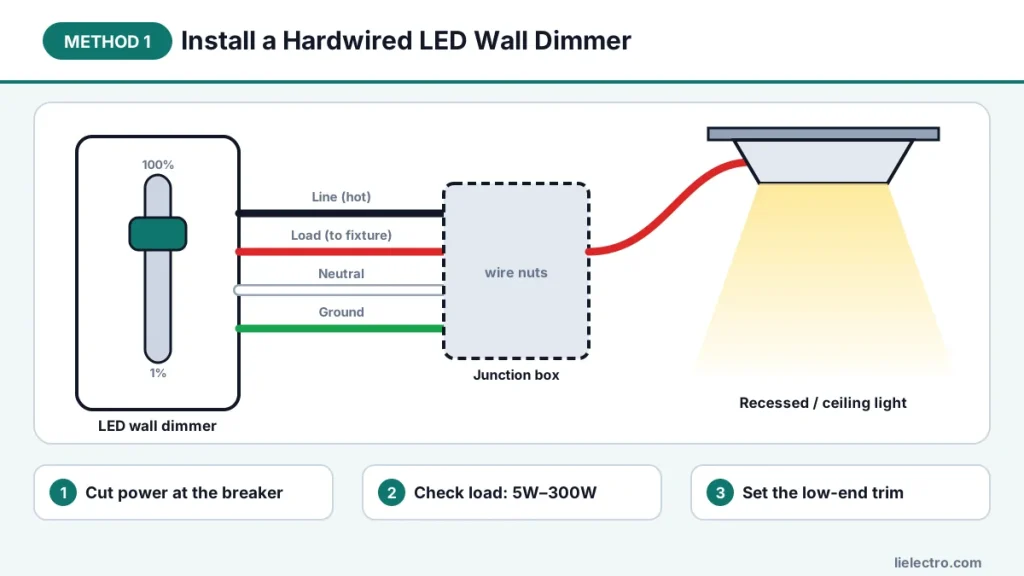
- Cut Power at the Breaker: Turn off the circuit breaker and confirm zero voltage inside the switch box with a non-contact voltage tester.
- Confirm Load Capacity & Neutral Wiring: Add up the total wattage of all LED bulbs on the circuit to ensure it sits between the dimmer’s minimum LED load (typically 5W) and maximum LED rating (typically 150W–300W). Follow compatibility of LED dimmer switch to verify load math and neutral wire requirements.
- Disconnect the Existing Switch: Unscrew the wall plate and label the Line (hot), Load (fixture), Neutral (white, if present), and Ground conductors before detaching them.
- Install the LED Dimmer: Join the dimmer leads to the matching box wires with wire nuts, seat the dimmer into the junction box, and fasten the faceplate. Use learn to choose the right dimmer switch for LED bulbs if you are selecting between trailing-edge and universal models.
- Calibrate the Low-End Trim: Restore breaker power, slide the dimmer to its lowest position, and turn the onboard calibration dial (low-end trim wheel) to lock in a stable minimum brightness level.
Method 2: Use a Plug-In or Inline PWM Dimmer (Table Lamps & LED Strips)
Fixtures that plug into standard wall outlets or run on low-voltage DC power supplies cannot use standard AC wall dimmers, instead, place a dimmer inline with the power cord:
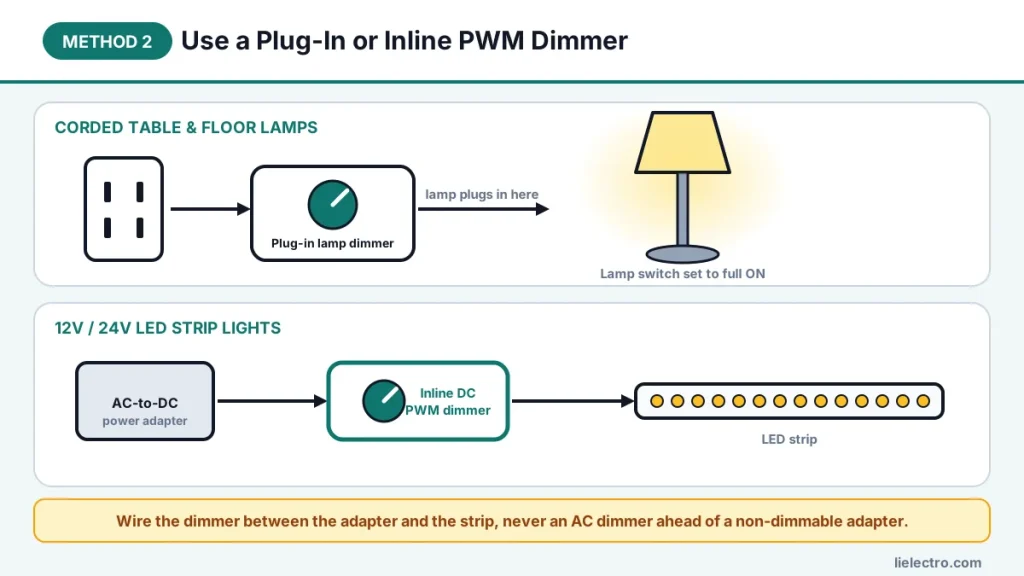
- Corded Table & Floor Lamps: Plug an LED-rated slide or rotary plug-in lamp dimmer into the wall outlet, connect your lamp plug into the dimmer module, and leave the lamp’s rotary switch set to full ON.
- 12V/24V LED Strip Lights: Wire a low-voltage inline DC PWM dimmer (rotary dial, touch sensor, or RF remote receiver) between the AC-to-DC power adapter and the LED strip. Never place an AC wall dimmer ahead of a non-dimmable plug-in LED strip power supply.
How to Dim LED Lights Without a Dimmer
If you rent your home, lack a neutral wire in older switch boxes, or want to control brightness without installing a hardwired wall dimmer or inline module, use one of these four dimmer-free solutions:
Method 3: Switch to Smart LED Bulbs (Wi-Fi, Matter, or Zigbee)
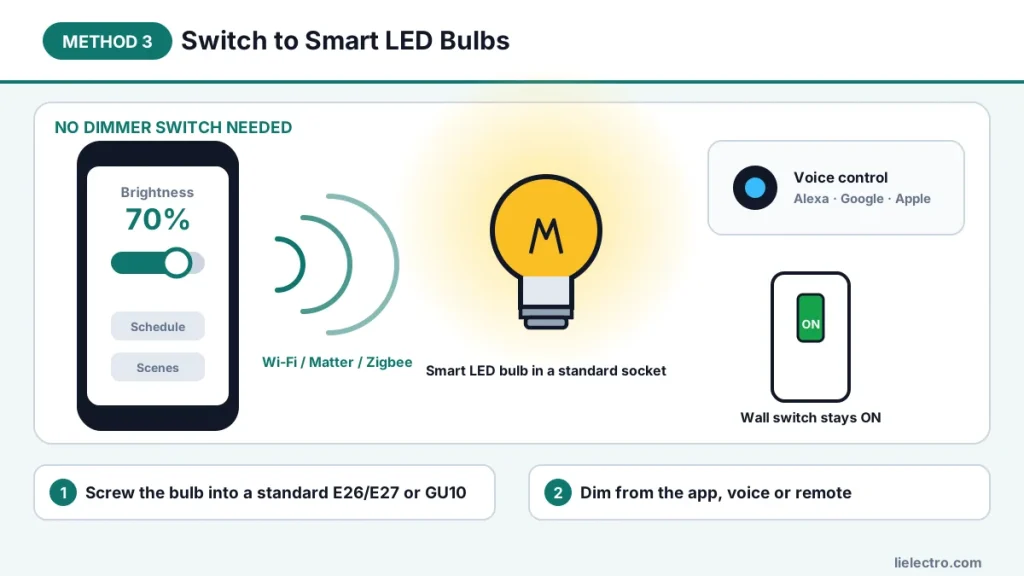
Screw a smart LED bulb into any standard E26/E27 or GU10 socket and keep your existing ON/OFF wall switch turned on. The bulb’s onboard microprocessor regulates brightness from 1% to 100% internally via digital Pulse Width Modulation (PWM), controlled through a smartphone app, voice assistant (Alexa, Google Home, Apple Home), or battery-powered wireless remote. (Read Working of Dimmable LED Lights to see how internal PWM drivers regulate light output.)
Important Wiring Rule: Never pair smart LED bulbs with a wall dimmer switch; phase-cut waveforms disrupt smart wireless radios even at 100% slider settings.
Method 4: Use 3-Way Dimmable LED Bulbs (For 3-Way Lamp Sockets)
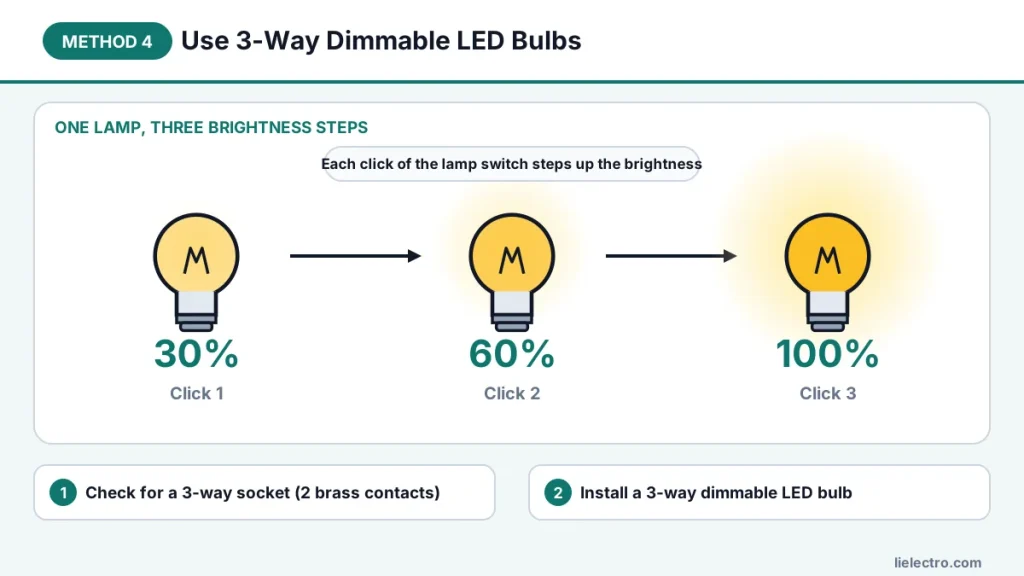
For table or floor lamps fitted with a 3-way socket (identifiable by two brass contacts at the base of the socket), install a 3-way dimmable LED bulb. Clicking the lamp’s mechanical switch energizes separate internal LED arrays to step through 30%, 60%, and 100% brightness with zero external electronics.
2 Bonus Dimmer-Free Workarounds
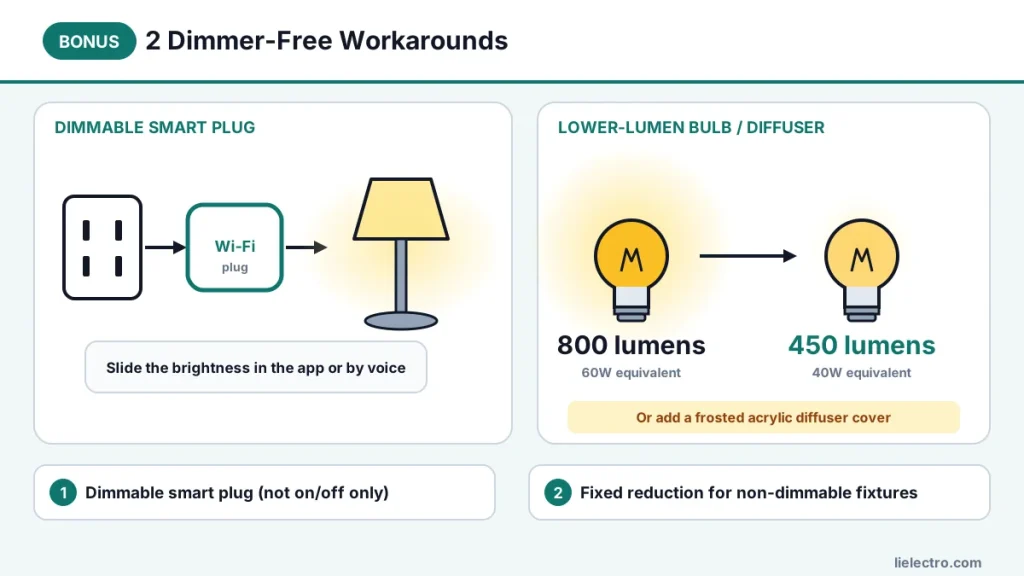
- Dimmable Smart Plugs: Plug a dimming-enabled smart plug (distinct from standard on/off smart plugs) into a wall outlet to control the brightness of standard dimmable LED lamp bulbs via app sliders or voice routines.
- Optical Diffusers or Lower-Lumen Bulbs (For Non-Dimmable Fixtures): If an integrated LED fixture cannot accept smart bulbs or external controls, lower perceived glare permanently by adding a frosted acrylic diffuser cover or swapping to a lower-lumen bulb (such as replacing an 800-lumen 60W equivalent with a 450-lumen 40W equivalent).
| Dimmer-Free Method | Best Fixture Type | Setup Time | Brightness Control | Approx. Cost |
| Smart LED Bulbs | Ceiling lights, sconces, lamps | 2–5 minutes | 1%–100% (app, voice, wireless remote) | $8–$20 per bulb |
| 3-Way Dimmable LED Bulb | Lamps with 3-way sockets | Under 1 minute | 3 fixed steps (30% / 60% / 100%) | $10–$16 per bulb |
| Dimmable Smart Plug | Corded table & floor lamps | 2 minutes | 1%–100% (app or voice) | $15–$25 per unit |
| Lower-Lumen Bulb / Diffuser | Non-dimmable fixtures & lamps | Under 1 minute | Fixed reduced lumen output | $4–$12 |
Pre-Installation Compatibility Checklist
Confirm these four technical parameters before energizing any dimmed LED circuit:
- Dimmable Driver Rating: Every bulb or external power supply on the circuit must carry an explicit Dimmable rating.
- Single-Brand Circuit Consistency: Install identical LED bulb models and wattages on the same dimmer switch so all lamps follow the exact same dimming curve.
- Minimum & Maximum Wattage Bounds: Verify combined bulb wattage exceeds the dimmer’s minimum LED load threshold without exceeding its maximum rated capacity.
- Isolated Smart Bulb Circuits: Keep smart LED bulbs strictly on standard ON/OFF toggle switches rather than phase-cut wall dimmers.
(Already wired your dimmer and noticing performance issues? Troubleshoot specific symptoms in Why Your Dimmable LED Lights Are Flickering and Fixing.
Final Verdict
Dimming LED lights comes down to matching your fixture type with the right control method, whether that means wiring a trailing-edge (ELV) wall dimmer switch for hardwired ceiling lights, adding a plug-in or inline DC PWM dimmer for lamps and LED strips, or using smart LED bulbs and 3-way dimmable bulbs when you want brightness control without touching wall wiring.
As long as your bulbs carry an explicit Dimmable rating and stay within your control device’s wattage limits, you will get smooth, reliable light adjustment across every room.
FAQ
Can you dim non-dimmable LED lights?
No. Non-dimmable LED bulbs use constant-current drivers that cannot process phase-cut or PWM dimmer signals. To dim a fixture currently using a non-dimmable bulb without rewiring the wall switch, replace the bulb with a dimmable LED or a smart LED bulb.
What is the best dimmer switch type for LED lights?
A trailing-edge (ELV) dimmer or universal LED-rated dimmer works best for modern LED bulbs. Trailing-edge dimmers switch off current smoothly at the end of each AC cycle, preventing stress on capacitive LED drivers and supporting low minimum wattage loads (typically 5W–10W).
How do I dim LED strip lights safely?
Connect a low-voltage DC inline PWM dimmer between the power supply adapter and the 12V or 24V LED strip. If you want wall-switch dimming for LED strip lights, replace the standard plug-in adapter with a hardwired dimmable LED driver (TRIAC or 0–10V) matched to your wall dimmer.
Leave a Reply