
|
Getting your Trinity Audio player ready... |
Quick Overview
Dimmable LED lights allow you to adjust brightness instead of relying on a fixed light output. They are available in bulbs, downlights, strip lights, and integrated fixtures, but each product must be specifically designed for dimming.
Unlike traditional incandescent bulbs, LEDs use electronic drivers, so they require compatible dimming controls. Understanding the different types of dimmable LEDs and their requirements can help you choose the right lighting for your space.
Dimmable LED light meaning refers to an LED bulb, fixture, or lighting product designed to adjust its brightness using a compatible dimmer or lighting control. Unlike standard non-dimmable LEDs, these products can provide different brightness levels instead of operating at a fixed light output.
Dim LED lights are available in bulbs, downlights, strip lights, and integrated fixtures. However, their performance depends on the LED driver, dimming method, and compatibility with the selected control.
Understanding the dimmable LED light meaning, how dimmable LEDs differ from non-dimmable ones, and what to check before buying can help you choose the right lighting and avoid compatibility problems..
What Are Dimmable LED Lights?
Dimmable LED lights are LED bulbs, fixtures, or other lighting products designed to adjust their light output with a compatible dimmer or lighting control.
A dimmable LED does not simply switch between on and off. Its brightness can be adjusted across a specified range, depending on the LED driver, dimmer, and control method.
The important point is that “dimmable” does not mean “compatible with every dimmer.” A dimmable LED bulb may work smoothly with one dimmer but flicker, buzz, or have a limited dimming range with another.
The overall system includes several connected components:
LED → LED driver → dimmer/control → wiring → electrical supply
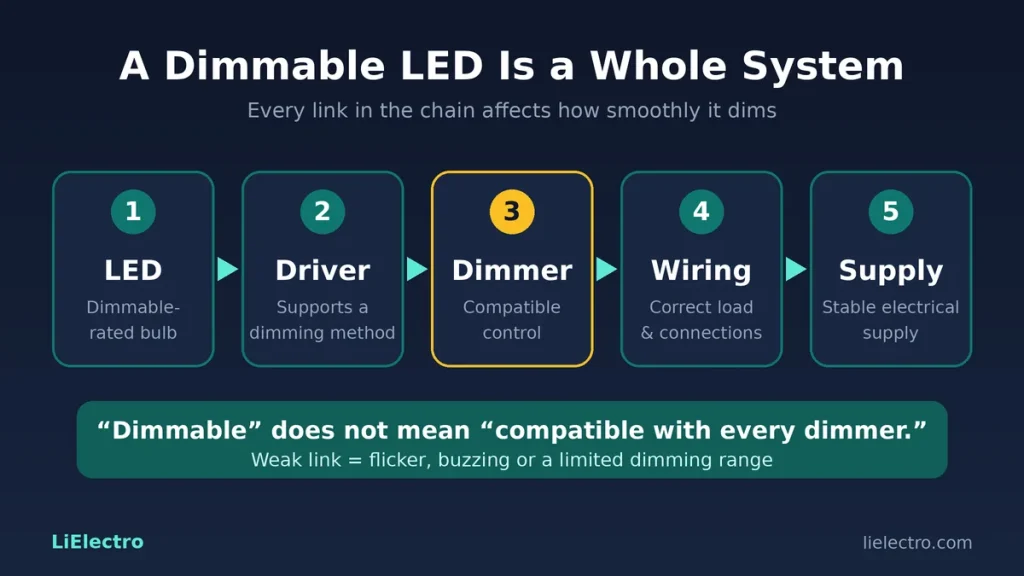
Each component can affect how the lighting system performs.
Understanding “Dimmable” Meaning on an LED Light?
dimmable led light bulbs meaning is that the product is designed to adjust its light output when used with an appropriate dimming system.
Dimmable LEDs are useful when you want to:
- Increase brightness for reading or detailed tasks
- Lower brightness for relaxing or watching TV
- Adjust lighting for different times of day
- Create different lighting levels in the same room
The actual dimming range varies by product, so check the manufacturer’s specifications rather than assuming every dimmable LED can reach the same minimum brightness.
Why LED Dimming Is Different From Incandescent Dimming
Traditional incandescent lamps produce light by heating a filament. LEDs use semiconductor components and electronic drivers, so their electrical behavior is different.
As a result, a dimmer that worked properly with an incandescent bulb may not provide the same results with an LED.
This is why LED and dimmer compatibility matters when replacing traditional bulbs with LED lighting.
For a deeper technical explanation, see [How Do Dimmable LED Lights Work?].
Dimmable vs. Non-Dimmable LED Lights
The main difference is whether the LED product and its driver are designed to respond to a compatible dimming control.
| Feature | Dimmable LED | Non-Dimmable LED |
|---|---|---|
| Brightness adjustment | Designed for dimming | Designed primarily for fixed output |
| Dimmer use | Requires a compatible dimmer/control | Not designed for dimmer operation |
| LED driver | Supports a specified dimming method | May not support dimming |
| Product labeling | Usually identified as dimmable | Usually identified as non-dimmable |
| Compatibility | Depends on the LED, driver, and dimmer | Should be used according to manufacturer instructions |
Dimmable LED Lights
A dimmable LED contains or uses a driver designed to respond to a supported dimming method. When paired with compatible controls, its light output can be adjusted.
The available dimming range varies between products.
Non-Dimmable LED Lights
Non-dimmable meaning is that LEDs are designed primarily for normal switching rather than continuous brightness adjustment.
Using a non-dimmable LED with a dimming system can cause undesirable behavior, depending on the product and electrical setup. Always follow the manufacturer’s instructions.
Can You Use a Non-Dimmable LED With a Dimmer?
A non-dimmable LED should not be treated as dimmer-compatible simply because it is an LED.
If the manufacturer does not specify dimming support, use the product according to its stated specifications. Check the label, product documentation, and manufacturer’s compatibility information before connecting it to a dimmer.
For a dedicated explanation, see Are All LED Lights Dimmable?.
What Types of LED Lights Can Be Dimmable?
Dimmability is available across several types of LED lighting, but the individual product must be designed for dimming.
| LED type | What to check |
|---|---|
| LED bulbs | Dimmable rating and compatible wall dimmer |
| LED downlights | Integrated or external driver and dimming method |
| LED strip lights | Compatible power supply and controller |
| Integrated LED fixtures | Built-in driver and supported control system |
Dimmable LED Bulbs
Dimmable LED bulbs are designed to replace conventional bulbs while allowing brightness adjustment with a compatible dimmer.
Check the individual bulb’s specifications because not every LED bulb is dimmable.
Dimmable LED Downlights
LED downlights are available in both dimmable and non-dimmable versions for residential, commercial, and architectural applications.
With integrated LED downlights, the driver is particularly important because it may be built into the fixture or supplied separately.
Dimmable LED Strip Lights
LED strip lighting can support dimming, but the appropriate control depends on the strip, power supply, and controller.
Some LED strip systems use dedicated controllers rather than a conventional wall dimmer.
Dimmable LED Fixtures
Integrated LED fixtures may use built-in drivers and specific control systems. Their dimming capabilities should therefore be checked in the manufacturer’s specifications before installation.
Do not assume an entire category of LED lighting is automatically dimmable. Check the individual product.
How Do I Know If My Led Lights Are Dimmable?
You cannot reliably identify a dimmable LED just by looking at its appearance. Check the product label, packaging, or manufacturer’s specifications.
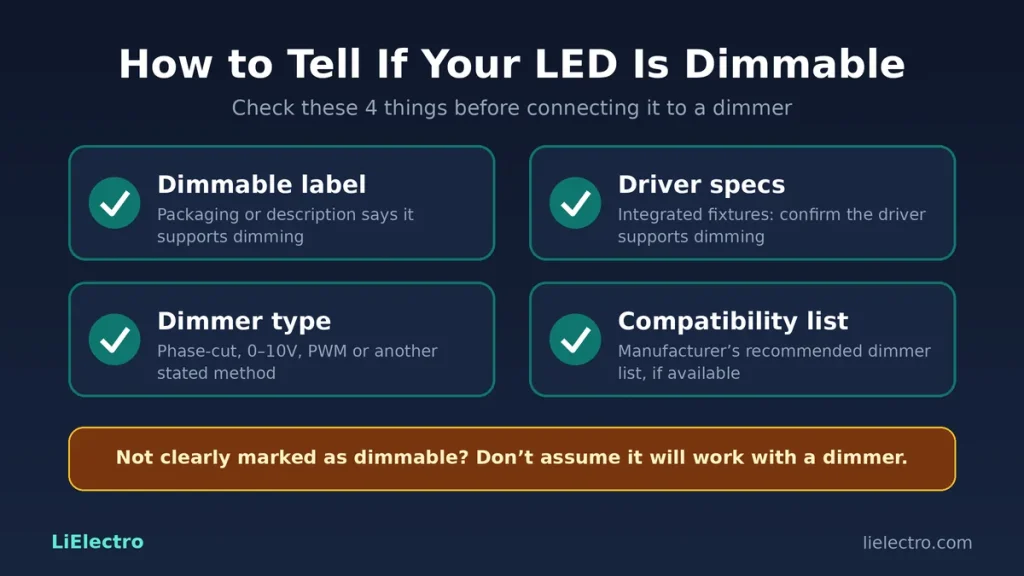
Look for:
- Dimmable label: The packaging or product description should explicitly state that the LED supports dimming.
- Driver specifications: For integrated fixtures, check whether the supplied driver supports dimming.
- Supported dimmer type: Check whether the product works with phase-cut, 0–10V, PWM, or another specified control method.
- Compatibility information: Consult the manufacturer’s recommended dimmer list when available.
If the product is not clearly marked as dimmable, do not assume it will work with a dimmer.
Final Takeaway
Dimmable LED lights are designed to adjust their brightness when paired with compatible dimming controls. Their performance depends on the relationship between the LED, its driver, the dimmer, the electrical load, and the supported dimming method.
Want to understand what happens when you adjust the brightness? Read our guide on dimmable LED lights working to learn how the dimmer, LED driver, and LED work together to control light output.
Before installing one, verify that the LED is rated for dimming and check its compatibility with the intended dimmer. That gives you a better chance of achieving smooth, predictable dimming and avoiding common issues such as flickering, buzzing, or limited brightness control.
FAQS
Are All LED Lights Dimmable?
No, not all LED lights are dimmable. Only LEDs specifically labeled “Dimmable” can adjust their brightness. Non-dimmable LEDs may flicker, buzz, or become damaged when connected to a dimmer switch. Always check the product packaging or specifications before purchasing.
How to Tell If an LED Light Is Dimmable?
To tell if an LED light is dimmable, check its packaging or product label for the word “Dimmable.” You can also review the manufacturer’s specifications or product manual for dimming information. Some LED bulbs have a dimming symbol printed on them. Additionally, check whether the bulb is compatible with your dimmer switch. If the LED is not clearly labeled as dimmable, assume it is non-dimmable to prevent flickering, buzzing, or potential damage.
What Does 10% Dimmable Mean?
10% dimmable means an LED light can reduce its brightness to as low as 10% of its maximum output. This allows you to create softer lighting for relaxing, watching TV, or setting a comfortable mood while still maintaining some illumination.
What Makes a Light Dimmable or Not?
A light is dimmable when its internal electronics and driver are designed to adjust the electrical power supplied to the light without causing flickering or damage. Non-dimmable lights lack this feature and are designed to operate at a fixed brightness level. For an LED light to dim properly, both the bulb’s driver and the dimmer switch must be compatible.
What Does 5% Dimmable Mean?
5% dimmable means an LED light can reduce its brightness to as low as 5% of its maximum light output. This allows you to enjoy very low, soft lighting for bedrooms, relaxing spaces, or nighttime use while maintaining control over the brightness.
Leave a Reply