|
Getting your Trinity Audio player ready... |
An LED Christmas lights guide helps you choose the right lights for your Christmas tree, roofline, windows, bushes, and outdoor decorations. The best option depends on the bulb shape, light color, installation location, power requirements, and decorating style.
LED Christmas lights are available in mini strings, C7 and C9 bulbs, icicle lights, net lights, projectors, pathway lights, and smart color-changing systems. They generally use less electricity than comparable incandescent lights and produce less heat, making them a practical choice for seasonal displays.
This guide explains how to compare Christmas light types, choose colors, plan your display, estimate energy costs, install lights safely, and maintain them for future holiday seasons.
Why Choose LED Christmas Lights?
LED Christmas lights combine energy efficiency with a wide range of decorative options. They are suitable for small indoor trees, large outdoor displays, and customized holiday lighting.
Key benefits include:
- Lower energy consumption: LEDs generally use less electricity than comparable incandescent Christmas lights.
- Long operating life: Quality LED bulbs can last through many holiday seasons when used and stored correctly.
- Less heat: LEDs typically produce less heat than incandescent bulbs, although plugs and damaged connections can still overheat.
- More color options: Choose warm white, cool white, multicolor, or customizable RGB lighting.
- Flexible designs: Different bulb shapes suit trees, rooflines, windows, bushes, and pathways.
- Reusable decorations: Durable sets can be stored and reused instead of replaced every year.
Actual energy savings and lifespan depend on the product, usage, environmental conditions, and build quality. Check the manufacturer’s specifications before comparing products.
Types of LED Christmas Lights
Different Christmas light types create different effects. Choosing the right format makes decorating easier and helps you achieve the appearance you want.
| Christmas light type | Best use | What to know |
|---|---|---|
| Mini LED string lights | Christmas trees, garlands, and wreaths | Small bulbs suit detailed decorating |
| 5mm wide-angle lights | Trees, shrubs, and larger displays | Create a broad, distributed light effect |
| M5 faceted lights | Bushes, trees, and greenery | Faceted covers create a sparkling appearance |
| C6 strawberry-shaped bulbs | Trees and shrubs | Offer a traditional Christmas bulb shape |
| G12 globe lights | Garlands, trees, and wreaths | Rounded bulbs create a smooth, decorative look |
| C7 bulbs | Windows, smaller rooflines, and outlines | Suitable for classic decorative displays |
| C9 bulbs | Rooflines and large outdoor displays | Larger bulbs are easier to see from a distance |
| Icicle and drip lights | Eaves, gutters, and porch edges | Create a hanging, cascading effect |
| Net lights | Bushes and hedges | Help distribute lights across broad surfaces |
| Wrap lights | Tree trunks and branches | Designed for wrapping around greenery |
| Pathway and stake lights | Walkways, driveways, and garden borders | Define outdoor routes and landscape edges |
| LED projectors | Exterior walls and garage doors | Cover larger surfaces with decorative patterns |
| Rope and strip lights | Selected architectural edges | Create continuous lines of light |
String lights and fairy lights
String lights are among the most versatile Christmas decorations. They work on trees, stair railings, windows, mantels, wreaths, and outdoor structures.
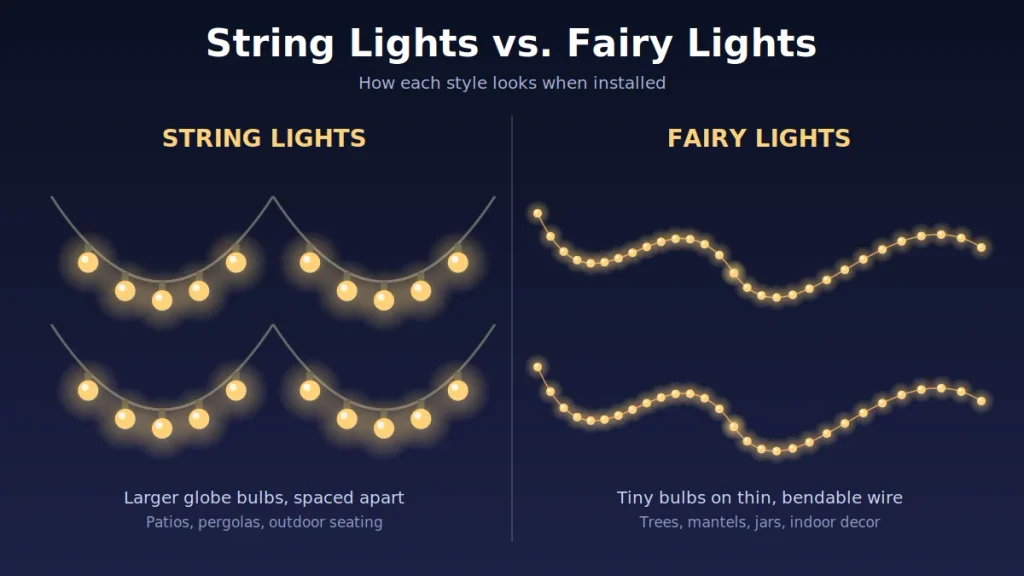
Fairy lights commonly use small bulbs and thin wires, making them suitable for delicate arrangements and detailed decorations.
When choosing a string, compare:
- Total string length and illuminated length.
- Bulb count and spacing.
- Wire color and flexibility.
- Indoor or outdoor suitability.
- Steady, twinkling, or other available effects.
For more detail, read our String Lights & Fairy Lights guide.
Icicle and drip lights
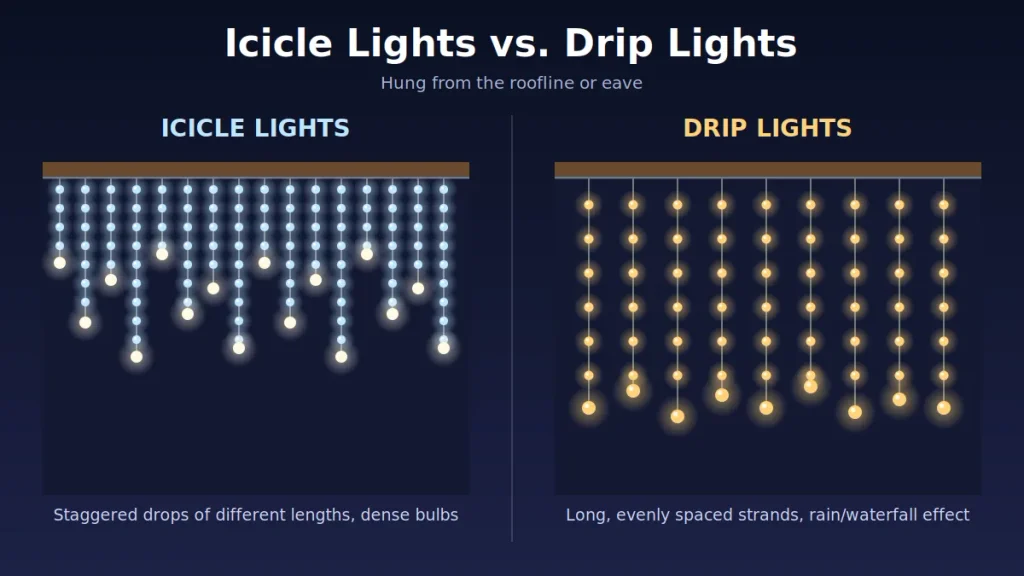
Icicle lights hang down from rooflines, eaves, porches, and other horizontal edges. Their cascading arrangement creates a winter-inspired display without requiring individual hanging lights.
Check the length of the hanging sections, spacing between drops, overall illuminated length, and outdoor rating before buying.
See our [Icicle & Drip Lights guide — INSERT INTERNAL LINK] for a more detailed comparison.
Net lights and wrap lights
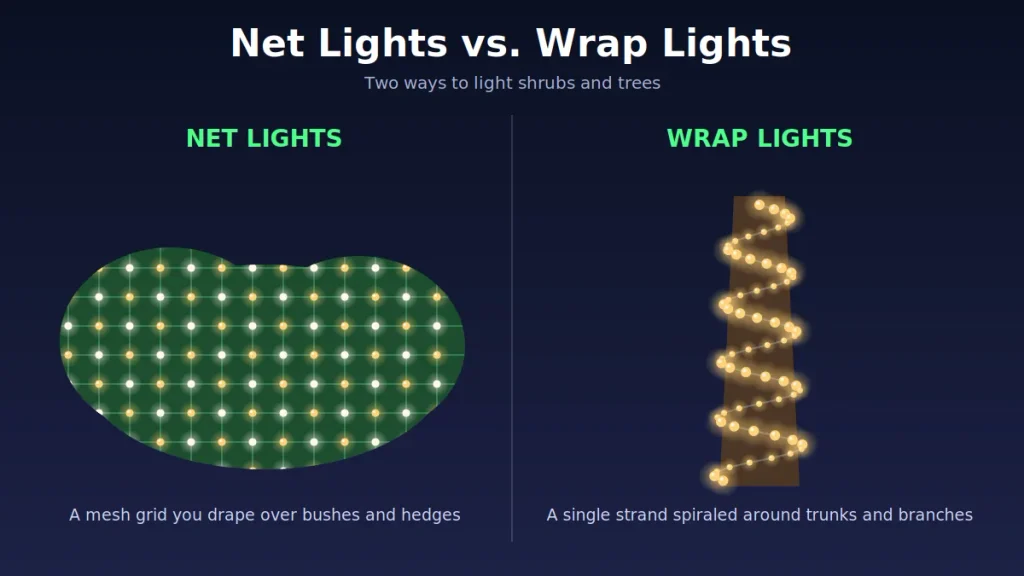
Net lights are designed to cover bushes and hedges with less manual arrangement. Wrap lights are more suitable for tree trunks, branches, and other narrow structures.
Choose net lights for broad, relatively uniform surfaces and wrap lights for decorations that need to follow the shape of a tree or branch.
Explore our [Net Lights & Wrap Lights guide — INSERT INTERNAL LINK] for selection and installation advice.
LED projectors and pathway lights
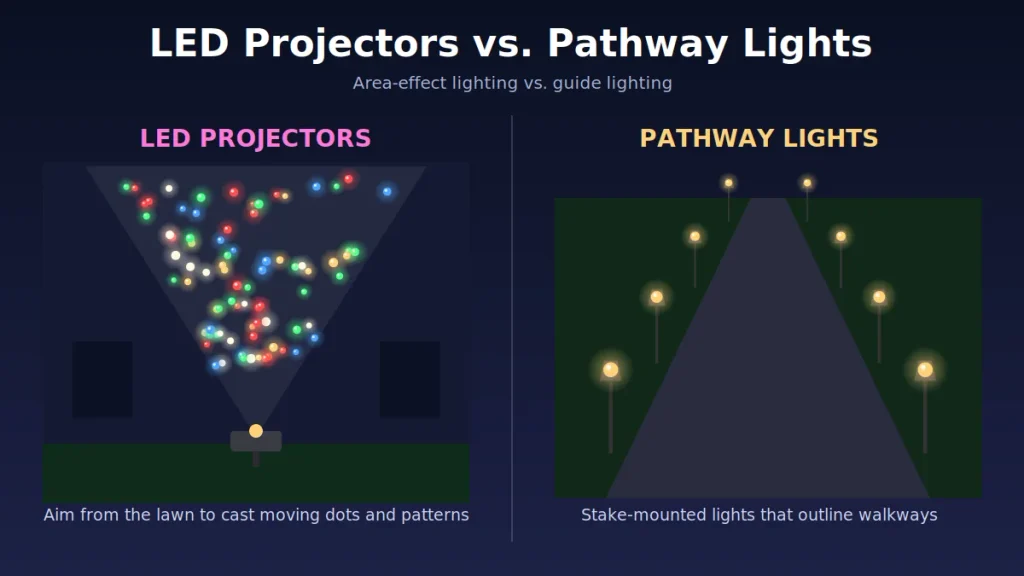
LED projectors display patterns across walls or other suitable surfaces. Pathway and stake lights mark walkways, driveways, and garden borders.
For projectors, consider projection distance, coverage area, available patterns, and the mounting location. For pathway lights, prioritize stable placement, outdoor suitability, and safe cable routing.
Read our [LED Light Projectors guide — INSERT INTERNAL LINK] and [Pathway & Stake Lights guide — INSERT INTERNAL LINK] for more information.
C6 vs. C7 vs. C9 Christmas lights
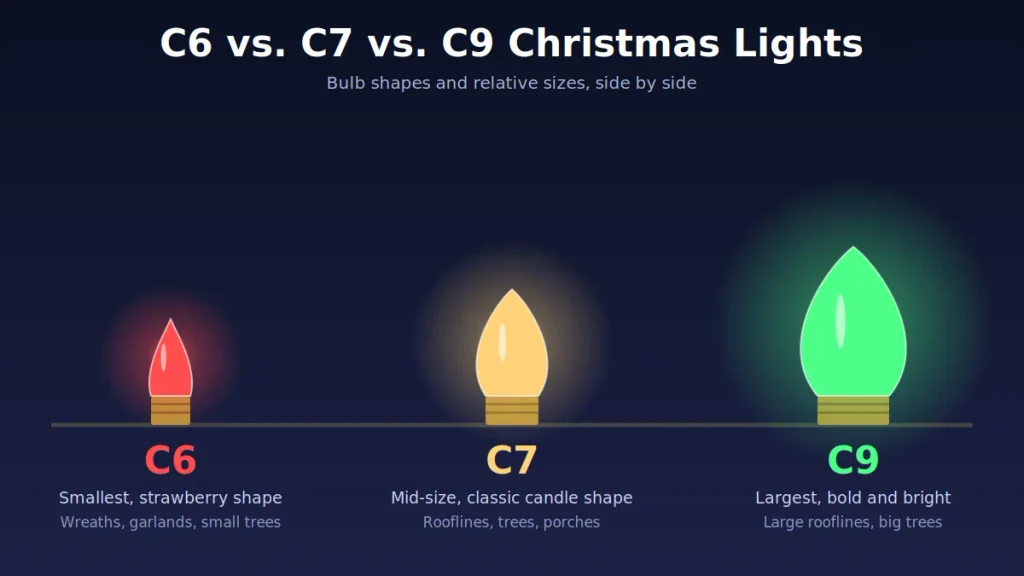
The main difference is bulb size and the type of display each bulb suits.
- C6: Smaller bulbs commonly used on trees and shrubs.
- C7: Medium-sized bulbs suitable for decorative outlines and smaller rooflines.
- C9: Larger bulbs often used on prominent rooflines and large outdoor displays.
Do not select a bulb based on size alone. Check its brightness, spacing, base compatibility, power requirements, and intended use.
Warm White, Cool White, and Multicolor Christmas Lights
Christmas light color changes the appearance of your entire display. Warm white creates a traditional atmosphere, cool white gives a crisp appearance, and multicolor lights create a playful, festive effect.
Warm white Christmas lights
Warm white lights produce a soft, yellowish glow similar to traditional incandescent Christmas lights.
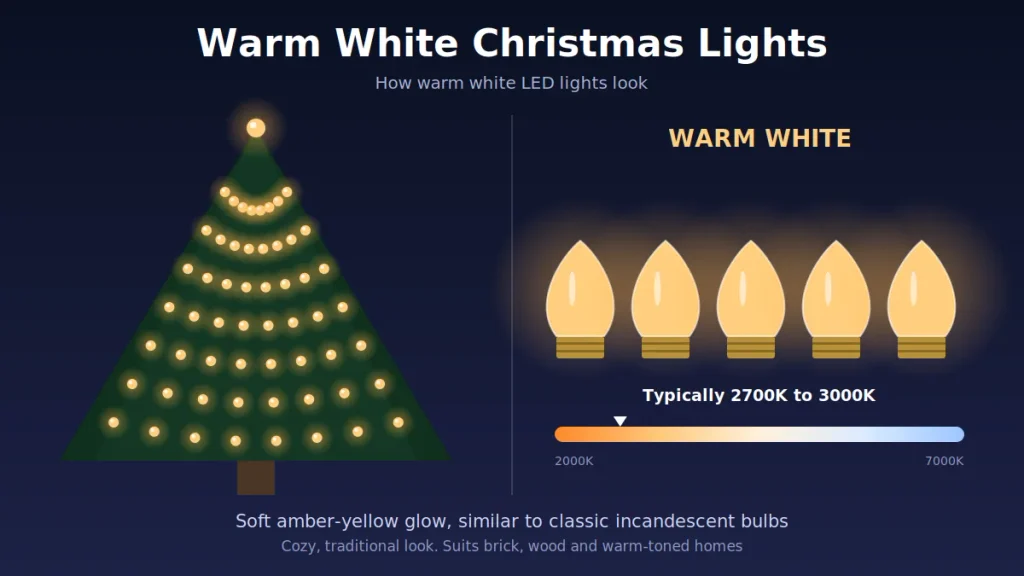
They work well with:
- Green Christmas trees and natural wreaths.
- Gold ornaments, red ribbons, and wooden decorations.
- Garlands, fireplaces, and cozy living-room displays.
- Traditional roofline and porch decorations.
Choose warm white if you prefer a classic holiday appearance.
Cool white Christmas lights
Cool white lights create a crisper, whiter appearance that complements modern decorations.
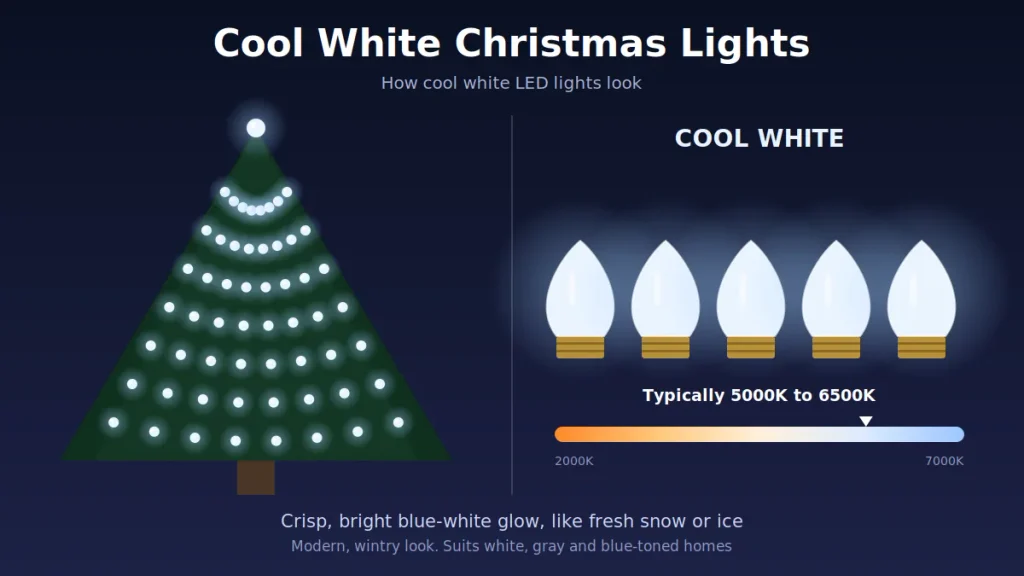
They are suitable for:
- Snow-themed displays.
- Silver ornaments and blue decorations.
- White artificial trees.
- Modern roofline lighting and architectural outlines.
Cool white does not automatically mean brighter. Actual brightness depends on the light output and design of the product.
Multicolor Christmas lights
Multicolor sets commonly combine red, green, blue, and other colors. Some smart models offer additional colors and customizable effects.
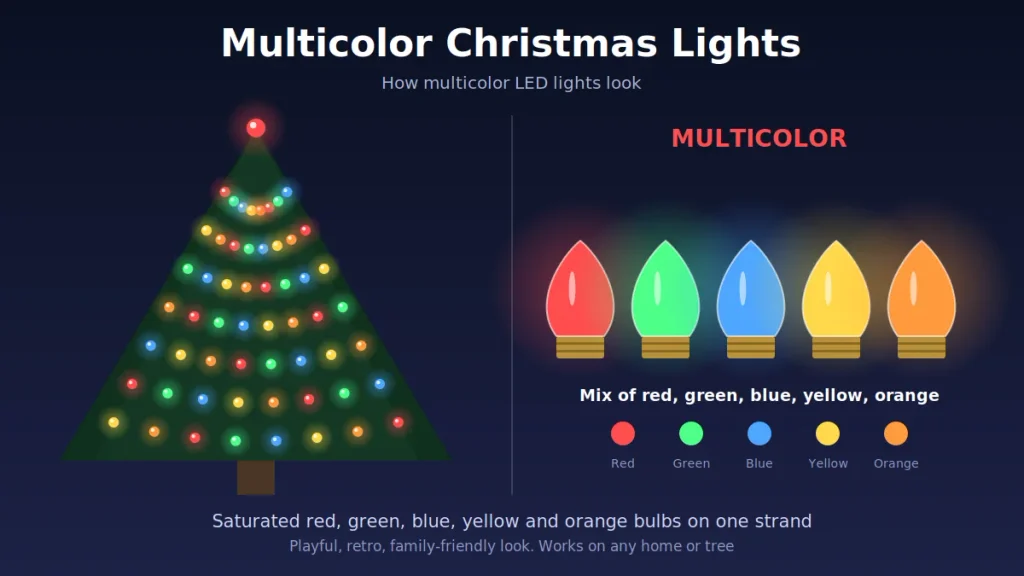
Multicolor lights are useful for:
- Family Christmas tree displays.
- Colorful outdoor decorations.
- Playful window and porch arrangements.
- Animated and music-synchronized displays.
Choose a consistent color scheme before buying multiple sets to avoid a cluttered appearance.
Which Christmas light colors should you choose?
| Decorating style | Recommended colors | Suitable locations |
|---|---|---|
| Traditional Christmas | Warm white, red, and green | Trees, garlands, and porches |
| Winter wonderland | Cool white and blue | Trees, windows, and rooflines |
| Elegant and understated | Warm white | Wreaths, mantels, and entryways |
| Colorful and playful | Multicolor | Trees, bushes, and family displays |
| Modern outdoor display | Cool white or controlled RGB colors | Rooflines and architectural outlines |
| Festive garden | Warm white or multicolor | Shrubs, pathways, and garden features |
For a more detailed christmas light color guide, see our dedicated color comparison article: [Multicolor vs Warm White Christmas Lights — INSERT INTERNAL LINK].
White vs. clear Christmas lights
The term clear can describe a transparent bulb cover rather than the color of the light itself. A clear bulb may emit warm white, cool white, or another color.
When comparing products, check both the bulb’s appearance and the manufacturer’s description of the emitted light. Do not assume that clear bulbs always produce a cool or neutral white glow.
Our detailed white vs clear christmas lights comparison explains how to interpret product descriptions and choose the appearance you want.
For shoppers comparing clear vs warm white lights, the key is to distinguish the bulb’s transparent cover from its actual light color.
Christmas LED Decorating Ideas by Room and Outdoor Space
A coordinated display looks more intentional when each area has a clear purpose. Choose light types and colors that suit the space rather than using every effect in one display.
| Location | Decorating idea | Suitable lights |
|---|---|---|
| Christmas tree | Distribute lights throughout the branches | Mini strings, C6, or globe lights |
| Living room | Highlight a mantel, shelf, or garland | Warm white string lights |
| Windows | Create a simple outline | String or icicle lights |
| Front porch | Frame the entrance and railing | String lights or suitable C7 bulbs |
| Roofline | Trace the edges of the home | C7 or C9 lights |
| Bushes and hedges | Create even coverage | Net lights or mini strings |
| Tree trunks | Highlight natural shapes | Wrap lights |
| Walkways | Mark the edges of a path | Outdoor-rated stake lights |
| Exterior walls | Add a broad decorative effect | LED projectors |
Keep your decorating scheme consistent
- Use one main color and one accent color for a coordinated appearance.
- Match warm white lights across the same display where possible.
- Measure each area before buying strings.
- Keep cables away from walking paths and door hinges.
- Use only lights suitable for the intended installation location.
For more room-by-room inspiration, read our [Decorating Ideas by Room guide — INSERT INTERNAL LINK].
How to Choose the Right LED Christmas Lights
Before buying, consider the location, bulb style, color, power requirements, and total cost. These factors help you avoid buying lights that do not fit your display.
1. Choose the location
Start by deciding where the lights will go.
- Trees and garlands: Mini strings, C6 bulbs, or globe lights.
- Rooflines: C7 or C9 bulbs.
- Bushes: Net lights or flexible strings.
- Pathways: Suitable outdoor stake lights.
- Windows and doors: Short strings or icicle lights.
- Exterior walls: Projectors with suitable coverage.
2. Check length and bulb spacing
Compare the illuminated length, total string length, bulb count, and spacing. Some products include a lead cable between the plug and the first bulb, so their total length may exceed the illuminated section.
3. Confirm the electrical and weather ratings
Check the manufacturer’s instructions for indoor or outdoor use, power requirements, connector compatibility, and maximum connection limits.
Outdoor lights must be suitable for the expected conditions. The plugs, adapters, controllers, and connectors may have different ratings from the light string itself.
4. Select the control type
Basic sets may use a simple plug, while other products offer timers, remotes, smartphone apps, or voice-assistant integration.
Choose the features you will actually use. More controls can add cost and setup complexity.
5. Compare durability and warranty
Review the product’s construction, warranty terms, replacement options, and customer feedback. For outdoor displays, pay particular attention to the suitability of the wiring and connections.
6. Set your budget
Compare the complete setup cost rather than the price of a single string. Include accessories, extension cords, controllers, replacement components, and electricity use where relevant.
Budget vs. Premium Christmas LED Lights
Budget and premium Christmas lights can both suit seasonal decorating. Their differences often involve controls, construction, effects, warranty coverage, and replacement options.
| Feature | Budget lights | Premium lights |
|---|---|---|
| Initial price | Usually lower | Usually higher |
| Lighting effects | Often basic or preset | May offer more customization |
| Smart controls | May be unavailable | More common in connected models |
| Construction | Varies by product | May offer upgraded materials |
| Replacement options | Depend on the model | May offer more supported components |
| Best suited for | Simple seasonal displays | Complex or customized displays |
Premium does not automatically mean better. Compare specifications, product reviews, warranty coverage, and compatibility before paying more.
For a detailed breakdown, visit our [Budget vs Premium Christmas Lights guide — INSERT INTERNAL LINK].
Comparing Christmas LED Light Brands
Compare specific products rather than relying on brand reputation alone. The same brand may sell basic string lights, outdoor bulbs, and advanced smart lighting systems with very different features.
Use these criteria when evaluating brands:
- Light quality: Color consistency, brightness, and available effects.
- Construction: Wire quality, connectors, and suitability for outdoor use.
- Installation: String length, mounting options, and power requirements.
- Controls: Timers, remotes, apps, and voice-assistant support.
- Compatibility: Connection limits and controller requirements.
- Warranty: Coverage, support, and replacement policies.
- Value: Total cost relative to the features you need.
When buying multiple sets of white lights, check that their color appearance matches. Products labeled warm white can look different across manufacturers.
See our [Christmas LED Light Brand Comparison — INSERT INTERNAL LINK] for product-specific comparisons.
Smart, Wi-Fi, and Music-Sync Christmas Lights
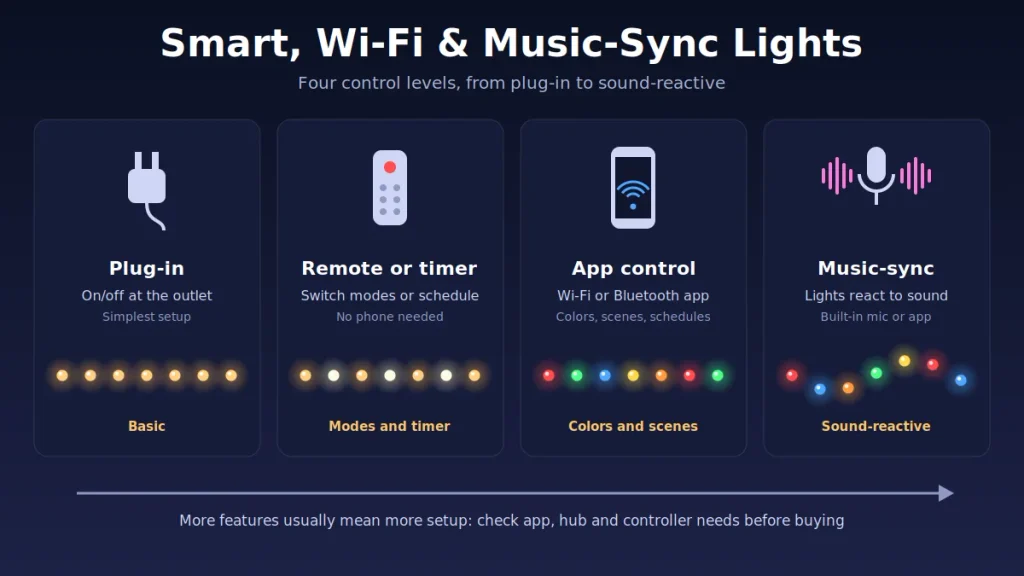
Smart and music-synchronized lights add customization to Christmas displays. They are useful when you want scheduled operation, changing colors, or animated effects.
Smart and Wi-Fi Christmas lights
Depending on the model, smart Christmas lights may allow you to:
- Change colors and lighting effects through an app.
- Schedule lights to turn on and off.
- Adjust brightness.
- Save customized scenes.
- Use compatible voice assistants.
Check whether the product uses Wi-Fi, Bluetooth, a hub, or a dedicated controller. Do not assume that every smart set supports the same apps or voice assistants.
Read our [Smart/Wi-Fi Christmas Lights guide — INSERT INTERNAL LINK] for more information.
Music-sync Christmas lights
Music-sync lights change colors or effects in response to music or an audio input. Some use a built-in microphone, while others require an app or separate controller.
Before purchasing, check the available effects, setup requirements, supported light quantity, and whether additional hardware is required.
Explore our [Music Sync Christmas Lights guide — INSERT INTERNAL LINK] for setup and selection advice.
Permanent vs. Seasonal Christmas Lighting
Permanent and seasonal lights serve different needs. Seasonal lights are installed for a particular period and stored afterward, while permanent systems are designed to remain installed.
| Consideration | Seasonal lights | Permanent lights |
|---|---|---|
| Installation | Temporary or seasonal | Intended to remain installed |
| Initial investment | Often lower | May be higher |
| Storage | Required between seasons | Usually unnecessary |
| Decorating flexibility | Easy to rearrange annually | Depends on the installed system |
| Maintenance | Inspect before each season | Inspect regularly |
| Best suited for | Traditional holiday decorating | Recurring displays and flexible lighting effects |
Choose seasonal lights if you enjoy changing your decorations every year. Permanent systems may suit homeowners who want recurring displays without reinstalling lights each season.
Permanent lighting still needs appropriate installation, maintenance, and weather protection.
Christmas Light Quantity and Energy Costs
Planning the number of lights and their power requirements before buying helps you avoid unnecessary expense and unsuitable connections.
How many Christmas lights do you need?
The required number depends on the tree’s size, the display area, bulb spacing, and the density you prefer.
For a six-foot Christmas tree, roughly 400–800 LED bulbs can be a starting estimate for a balanced display. The actual requirement varies with tree width, branch density, bulb size, and personal preference.
To estimate your requirements:
- Measure the tree or decorating area.
- Decide how dense you want the display.
- Check each product’s bulb count and illuminated length.
- Account for the shape and depth of the area.
- Follow the manufacturer’s instructions for connecting strings.
For rooflines, measure the length to be covered and compare it with the illuminated length of the chosen product.
Calculate Christmas LED lighting energy costs
Electricity use depends on total wattage and operating time. You can estimate the energy consumption of a Christmas display with a simple formula.
Electricity consumed (kWh) = Total wattage ÷ 1,000 × Hours used
Electricity cost = Electricity consumed (kWh) × Electricity rate per kWh
For example, a display using 60 watts for six hours daily over 30 days would operate for 180 hours.
- Total power: 60 watts
- Total operating time: 180 hours
- Electricity consumed: 60 ÷ 1,000 × 180 = 10.8 kWh
- Estimated cost: 10.8 × your electricity rate per kWh
This is an illustration, not a universal cost estimate. Use your actual wattage, operating hours, and electricity rate.
How to reduce Christmas lighting costs
- Choose LED lights instead of comparable incandescent sets.
- Use timers to reduce unnecessary operating hours.
- Turn off displays when they are not needed.
- Choose the appropriate number of strings for your space.
- Check the total power requirements of the complete setup.
Use our [Christmas LED Energy Savings Calculator — INSERT INTERNAL LINK] to estimate your display’s electricity consumption and running cost.
Indoor and Outdoor Christmas Light Installation
Safe installation starts with choosing lights designed for the location and planning how they will be powered.
Setting up Christmas lights indoors
For trees, windows, garlands, and other indoor decorations:
- Test each string before hanging it.
- Plan the route from the outlet to the display.
- Keep cords away from walking paths and door hinges.
- Avoid pinching, crushing, or stapling electrical wires.
- Keep connections away from moisture.
- Follow the product’s instructions for connecting multiple strings.
For Christmas trees, distribute lights through the branches rather than concentrating them only on the outside.
Read our [Indoor Christmas Lights Setup guide — INSERT INTERNAL LINK] for more detailed instructions.
Installing Christmas lights outdoors
Outdoor displays need products and accessories suitable for the expected weather and installation conditions.
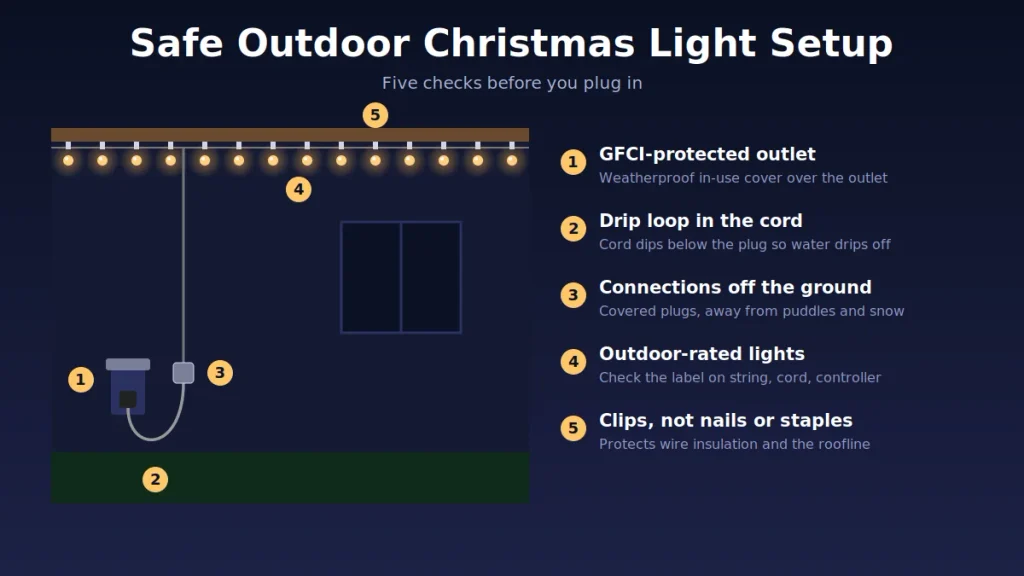
- Use outdoor-rated lights and appropriate mounting clips.
- Keep cords and connectors protected as instructed.
- Avoid damaging rooflines, gutters, and electrical cables.
- Place pathway lights so they do not create tripping hazards.
- Avoid ladder work in wet, icy, or windy conditions.
- Use a qualified professional for difficult roof access or electrical work.
Check the weather rating of the light string, power supply, controller, and connections separately. An outdoor rating does not mean a product can be submerged or exposed to every weather condition.
See our [Outdoor Christmas Lights Installation Guide — INSERT INTERNAL LINK] for a step-by-step overview.
Planning Christmas lights around existing outlets
Before decorating, identify suitable outlets and measure the distance to the display. Planning the cable route helps prevent excessive extensions and unsafe connections.
- Locate the nearest appropriate outlet.
- Measure the distance to the first light and the full display.
- Use extension cords rated for the location and electrical load.
- Avoid routing cables through doors or windows where they may be crushed.
- Keep connections protected as directed by the manufacturer.
- Do not overload outlets or connect extension cords in ways prohibited by their instructions.
Outdoor receptacles should have the required protection for the installation. Consult a qualified electrician if the existing outlet or circuit is unsuitable.
For more guidance, read our [Existing Outlet Integration guide — INSERT INTERNAL LINK].
Christmas LED Light Power Consumption and Safety
LED lights generally consume less power than comparable incandescent lights, but electrical safety still matters. Overloaded connections, damaged wiring, and unsuitable outdoor installations can create hazards.
How many LED Christmas light strings can you connect together?
There is no universal safe number. The maximum depends on the specific product, its electrical ratings, the power supply, and the manufacturer’s connection instructions.
Before connecting multiple strings:
- Check the manufacturer’s maximum end-to-end connection limit.
- Review the total wattage or current of the connected lights.
- Confirm that the power supply, extension cords, and circuit are suitable.
- Use only compatible strings designed to connect together.
- Do not exceed any stated electrical or connection limit.
Do not assume that a connection limit for one brand or model applies to another.
Essential Christmas light safety rules
- Inspect plugs, wires, bulbs, and connectors before use.
- Do not use strings with frayed, cracked, or crushed wiring.
- Keep indoor-only products indoors.
- Protect outdoor connections according to the product instructions.
- Avoid overloading outlets and extension cords.
- Follow the manufacturer’s directions for controllers and timers.
- Disconnect lights before inspecting or repairing them.
- Stop using lights if a plug, wire, or connector becomes unusually hot or produces a burning smell.
Follow the product instructions regarding unattended operation, and turn off or unplug lights when appropriate.
For a detailed breakdown, read our [Christmas Light Power Consumption & Safety guide — INSERT INTERNAL LINK].
Storage, Maintenance, and Troubleshooting
Inspecting and storing Christmas lights correctly helps preserve working sets and makes next season’s installation easier.
How to store Christmas LED lights
Before putting lights away:
- Disconnect the power.
- Inspect strings for damage and loose connections.
- Allow wet or damp products to dry according to the manufacturer’s instructions.
- Coil wires loosely to prevent tangling and damage.
- Label strings by location, color, or length.
- Store them in a dry place away from excessive heat and crushing.
Do not store damaged strings with working products for later use.
For more detailed advice, see our [Christmas LED Lights Storage & Maintenance guide — INSERT INTERNAL LINK].
Common Christmas light problems
| Problem | Possible cause | What to check |
|---|---|---|
| Entire string is off | Power or connection issue | Outlet, plug, controller, and connections |
| One section is dark | Failed bulb or component | Manufacturer troubleshooting instructions |
| Lights flicker unexpectedly | Loose connection or power issue | Connections, controller, and power supply |
| Smart lights will not connect | Setup or network issue | App instructions and compatibility |
| White lights look mismatched | Different products or color settings | Model specifications and color output |
| Outdoor lights fail after rain | Moisture exposure or unsuitable connections | Product rating and connection protection |
Follow the manufacturer’s troubleshooting instructions. Replace damaged strings when they cannot be safely repaired. Do not bypass fuses, open sealed controllers, or attempt repairs beyond the manufacturer’s guidance.
Read our [Christmas LED Lights Troubleshooting & Repair guide — INSERT INTERNAL LINK] for further help.
Timing, Lifespan, and Sustainability
Planning your installation and taking care of your lights can help you reuse them for future holiday seasons.
When should you install Christmas lights?
Install lights when you have enough time to test the display and correct problems safely. For outdoor work, choose suitable weather conditions and avoid wet, icy, or windy conditions that increase the risk of falls or electrical hazards.
Arrange professional help for difficult rooflines or installations that require electrical work.
How long do LED Christmas lights last?
LED bulbs can have a long operating life, but the complete string may not last as long as the bulbs themselves. Wiring, connectors, controllers, moisture exposure, and storage conditions all affect longevity.
Check the manufacturer’s lifespan estimate and warranty. Treat published figures as estimates rather than guarantees for the entire light string.
Our [Christmas Light Timing & Lifespan guide — INSERT INTERNAL LINK] covers installation timing, product life, and replacement considerations.
How to make Christmas lighting more sustainable
- Choose durable products suitable for their intended location.
- Reuse working lights instead of replacing them every season.
- Store strings carefully to prevent damage.
- Use timers to reduce unnecessary electricity consumption.
- Choose repairable products when practical.
- Follow local requirements for disposing of electrical products and batteries.
LEDs can reduce electricity consumption compared with comparable incandescent lights, but sustainability also depends on product lifespan, repairability, materials, and disposal.
For more information, see our [Sustainable & Reusable Christmas LED Lighting guide — INSERT INTERNAL LINK].
FAQs
Are LED Christmas lights better than incandescent lights?
LED Christmas lights generally use less electricity, produce less heat, and have a longer potential operating life than comparable incandescent lights. Product quality, cost, and intended use still matter.
How many LED Christmas lights can you connect together?
The maximum depends on the product’s electrical specifications and manufacturer instructions. Check the stated end-to-end connection limit instead of relying on a general number.
Are warm white or cool white Christmas lights better?
Warm white suits traditional, cozy decorations, while cool white provides a crisper appearance. Choose according to your decorating style and the colors of your ornaments and surroundings.
Can indoor Christmas lights be used outdoors?
Only use lights specifically rated for outdoor use in the intended conditions. Indoor-only strings may not provide sufficient protection against moisture and weather.
Why do LED Christmas lights flicker?
Flickering can result from loose connections, a faulty power supply, a controller issue, or incompatible equipment. Disconnect the lights before inspection and follow the manufacturer’s troubleshooting instructions.
Can I leave Christmas LED lights on overnight?
Follow the manufacturer’s instructions and ensure the entire installation is suitable for its intended use. Turn off or unplug lights when appropriate, and never leave damaged or overheating lights operating unattended.
Should I get C7 or C9 Christmas lights?
Choose C7 Christmas lights for smaller rooflines, windows, and detailed decorations, and C9 Christmas lights for larger rooflines and outdoor displays. C9 bulbs are larger and more visible from a distance, while C7 bulbs offer a more subtle look.
How do I know if my Christmas lights are C7 or C9?
Check the product packaging or manufacturer’s specifications for the bulb size and model. C7 bulbs are approximately 2 inches long, while C9 bulbs are approximately 3 inches long. You can also compare the bulb base and socket size, but check the product specifications to confirm the type.
Final Tips
The best Christmas LED lights suit your decorating plan, provide the appearance you want, and meet the electrical and environmental requirements of the installation.
Before buying, check the bulb type, color, illuminated length, indoor or outdoor rating, power requirements, and connection limits. Plan the layout, compare running costs, and store reusable lights carefully after the season.
Explore our detailed Christmas lighting guides to compare specific light types, choose colors, plan installations, estimate energy costs, and troubleshoot common problems.





Leave a Reply